Neurotechnology has long chased a deceptively simple goal: speak the brain's language. Neurons don't communicate with ones and zeros. They trade in spikes-brief, patterned bursts of voltage that carry information through timing, frequency, and rhythm.
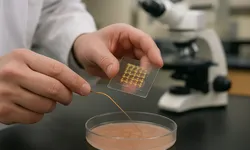
Engineers at Northwestern University now report a step toward that goal with printed artificial neurons that can do more than mimic neural behavior on a lab bench. The devices can directly interact with living brain cells, generating electrical signals that resemble the real thing and exchanging activity with biological neurons.
The work sits at the intersection of soft electronics, bioelectricity, and neural engineering. It also raises a practical question for the field: what happens when "brain-like" hardware becomes cheap, flexible, and printable rather than rigid, expensive, and difficult to scale?
Why "neuron-like" signals matter
Most electronic systems are built around steady voltages and digital logic. Neurons are different. They integrate incoming signals over time, and when a threshold is reached they fire an action potential-a stereotyped spike that propagates along the cell and triggers chemical release at synapses.
That spike is not just a pulse. Its timing relative to other spikes can encode meaning. Networks of neurons also produce collective rhythms, and those rhythms can shift with attention, movement, sleep, or disease. For an implanted device to interact naturally with neural tissue, it helps if the device can generate and respond to patterns that resemble what neurons already use.
Traditional neural interfaces often rely on electrodes that record or stimulate with relatively simple waveforms. That approach can work, but it can also be blunt. Stimulation may recruit many cells at once, and the interface between stiff materials and soft tissue can complicate long-term performance. A device that behaves more like a neuron-producing lifelike spikes and adapting in neuron-like ways-offers a different route: communicate with the nervous system using signals that look familiar to it.
From rigid implants to soft, printed bioelectronics
The nervous system is mechanically delicate. Brain tissue is soft and moves slightly with each heartbeat and breath. Many conventional electronics are comparatively rigid. Even when implants are miniaturized, mechanical mismatch can contribute to inflammation and scarring around electrodes, which can degrade signal quality over time.
That's one reason researchers have explored flexible substrates, stretchable conductors, and polymer-based electronics. Printing techniques-rather than conventional semiconductor fabrication-add another dimension. Printing can reduce cost, enable rapid prototyping, and support large-area or unusual form factors that are hard to achieve with standard cleanroom processes.
Northwestern's printed artificial neurons fit into this broader push toward soft bioelectronics. The headline detail is not only that the devices are flexible and low-cost, but that they can generate electrical activity that resembles biological neural firing and can directly interact with living brain cells.
What an "artificial neuron" is in this context
An artificial neuron can mean several things. In artificial intelligence, it's a mathematical function in a neural network. In neuromorphic engineering, it's a circuit element that emulates the dynamics of real neurons-integrating inputs, firing spikes, and resetting-often to build energy-efficient computing systems.
Here, the term points to a physical device designed to reproduce the electrical behavior of a neuron closely enough to interface with biological neurons. That implies more than outputting a generic pulse. It suggests the ability to generate spike-like waveforms and potentially adjust firing patterns in response to inputs, the way real neurons do.
The key claim from the Northwestern work is functional interaction: the printed devices can communicate with living brain cells. That implies a two-way relationship at the electrical level-at minimum, the artificial neuron can drive activity that biological neurons respond to, and the biological side can influence the device's behavior in return.
How printed devices can produce lifelike spikes
Biological neurons are nonlinear systems. They don't respond proportionally to input; they accumulate charge across membranes and then switch rapidly into a firing state. To emulate that electronically, engineers typically use circuits that incorporate nonlinear components and feedback.
In conventional silicon, that might be done with transistors and capacitors. In printed electronics, the palette is different. Printed components can be made from conductive inks, semiconducting polymers, and other solution-processable materials. The challenge is to achieve stable, repeatable dynamics with materials that may vary more than silicon and that operate in environments closer to biology-often wet, ionic, and temperature-sensitive.
The Northwestern team's approach, as described, produces electrical signals that are "lifelike," which points to spike shapes and firing behaviors that resemble those of neurons. That matters because neurons are sensitive not only to whether they are stimulated, but to the pattern of stimulation. A device that can reproduce realistic patterns could, in principle, engage neural circuits more selectively than a simple periodic pulse train.
What "communicate with real brain cells" implies
Communication between an artificial device and neurons can be framed in a few ways. One is recording: the device detects electrical activity from cells. Another is stimulation: the device injects current or voltage to trigger activity. The most ambitious form is closed-loop interaction, where the device both reads and writes in real time, adjusting its output based on what it senses.
The Northwestern report emphasizes direct interaction, which suggests the artificial neurons can participate in a feedback relationship with living cells. In a lab setting, that might involve cultured neurons or brain slices placed near the device, where electrical coupling can be tested under controlled conditions.
If the artificial neuron can drive biological neurons with spike-like outputs, it could act as a kind of synthetic partner in a network. If it can also respond to the biological neurons' activity, it begins to resemble a bridge element-something that could one day sit between damaged parts of a circuit or provide a more naturalistic interface for prosthetic control.
Potential applications: from nerve repair to brain-machine interfaces
The immediate implications are easiest to see in therapeutic neurostimulation and neural prosthetics. Today's devices-such as deep brain stimulators, spinal cord stimulators, and peripheral nerve stimulators-already use electricity to treat symptoms. They typically deliver patterned stimulation through electrodes, sometimes with sensing and adaptive control.
Artificial neurons that generate lifelike spikes could expand the design space for these therapies. Instead of imposing an external rhythm, a device might be tuned to interact with existing neural dynamics, potentially enabling more precise modulation. That's a hypothesis, not a guarantee, but it's a direction researchers have pursued for years under the umbrella of biomimetic stimulation.
There is also a longer-term vision: neural "bridges." If a neural pathway is interrupted-by injury or disease-an interface that can read activity on one side and recreate appropriate spiking patterns on the other could, in principle, restore communication. Some experimental systems already attempt versions of this with conventional electronics and algorithms. A printed artificial neuron that behaves more like the tissue it connects to could make such bridges smaller, softer, and potentially more compatible with long-term implantation.
Brain-machine interfaces (BMIs) are another obvious arena. Many BMIs focus on recording, decoding intent, and controlling external devices. But future BMIs may need richer "write-back" channels for sensory feedback-touch, proprioception, or even more complex sensations. Delivering that feedback in a way the brain can interpret reliably is a major challenge. Devices capable of neuron-like signaling could become part of that solution.
Why flexibility and cost could reshape the field
Neural interfaces are often bespoke. They can be expensive to fabricate, difficult to customize, and challenging to scale. Printing changes the economics and the iteration cycle. If artificial neurons can be printed reliably, researchers could test many designs quickly, tailor geometries to different tissues, and explore arrays or distributed networks without the same manufacturing overhead.
Flexibility also matters beyond comfort. A conformal device can maintain better contact with tissue, which can improve signal coupling for both recording and stimulation. In peripheral nerves, where structures are small and movement is constant, a soft interface can be especially valuable.
Low-cost fabrication could also broaden access for research labs and accelerate experimentation. That doesn't automatically translate to low-cost medical products-regulatory, packaging, sterilization, and long-term reliability requirements are substantial-but it can change how quickly the underlying science advances.
Technical hurdles that still loom large
Interacting with living brain cells in a controlled setting is a major milestone, but it is not the same as a chronic implant. The body is a harsh environment for electronics. Materials must remain stable in ionic fluids, resist corrosion, and avoid leaching harmful substances. Encapsulation is difficult when the device must still interface electrically with tissue.
Signal stability over time is another challenge. Printed devices can show variability from one print to the next, and their properties can drift with temperature, humidity, and mechanical strain. For neuromorphic behavior, small changes in component values can alter firing patterns. That may be manageable with calibration and feedback, but it adds complexity.
Then there is the biological response. Even soft materials can trigger immune reactions. The nervous system's response to long-term presence of a device depends on chemistry, surface properties, micromotion, and many other factors. Demonstrating reliable, safe performance over months or years is a different category of work than demonstrating communication in vitro.
Power and integration also matter. An artificial neuron that produces lifelike spikes needs a power source and control circuitry, unless it is designed to operate with minimal external electronics. For implantable systems, power budgets are tight, and wireless communication introduces its own constraints.
Industry implications: neuromorphic hardware meets medical devices
The line between neuromorphic computing and medical neurotechnology has been blurry for a while. Neuromorphic engineers build spiking circuits to compute efficiently. Neuroengineers build interfaces to record and stimulate tissue. Artificial neurons that can communicate with living cells pull those worlds closer.
If printed artificial neurons mature, they could influence both sectors. On the medical side, device makers may gain new building blocks for stimulation waveforms and closed-loop control. On the computing side, researchers may find that biologically grounded spiking elements are useful not only for computation but also for hybrid bio-electronic systems-platforms where living neurons and artificial ones form mixed networks for research or specialized sensing.
There are also implications for how neurotechnology is prototyped. Printing could enable rapid design cycles and more customized interfaces, which is attractive in a field where anatomy and clinical needs vary widely. It may also encourage modular approaches, where arrays of artificial neurons are combined and tuned for specific tasks.
What to watch next
The next questions are practical. How robust is the communication between artificial and biological neurons across different conditions? How precisely can the artificial neurons be tuned, and how stable are they over time? Can the approach scale from single devices to arrays without losing reliability?
Equally important is the path from lab demonstrations to systems that could be tested in more complex biological settings. That includes packaging, biocompatibility, and integration with sensing and control electronics.
For now, Northwestern's printed artificial neurons add a compelling new tool to the neurotechnology toolkit: a flexible, potentially low-cost device that doesn't just stimulate or record, but aims to participate in neural communication using signals that look and behave like the brain's own.