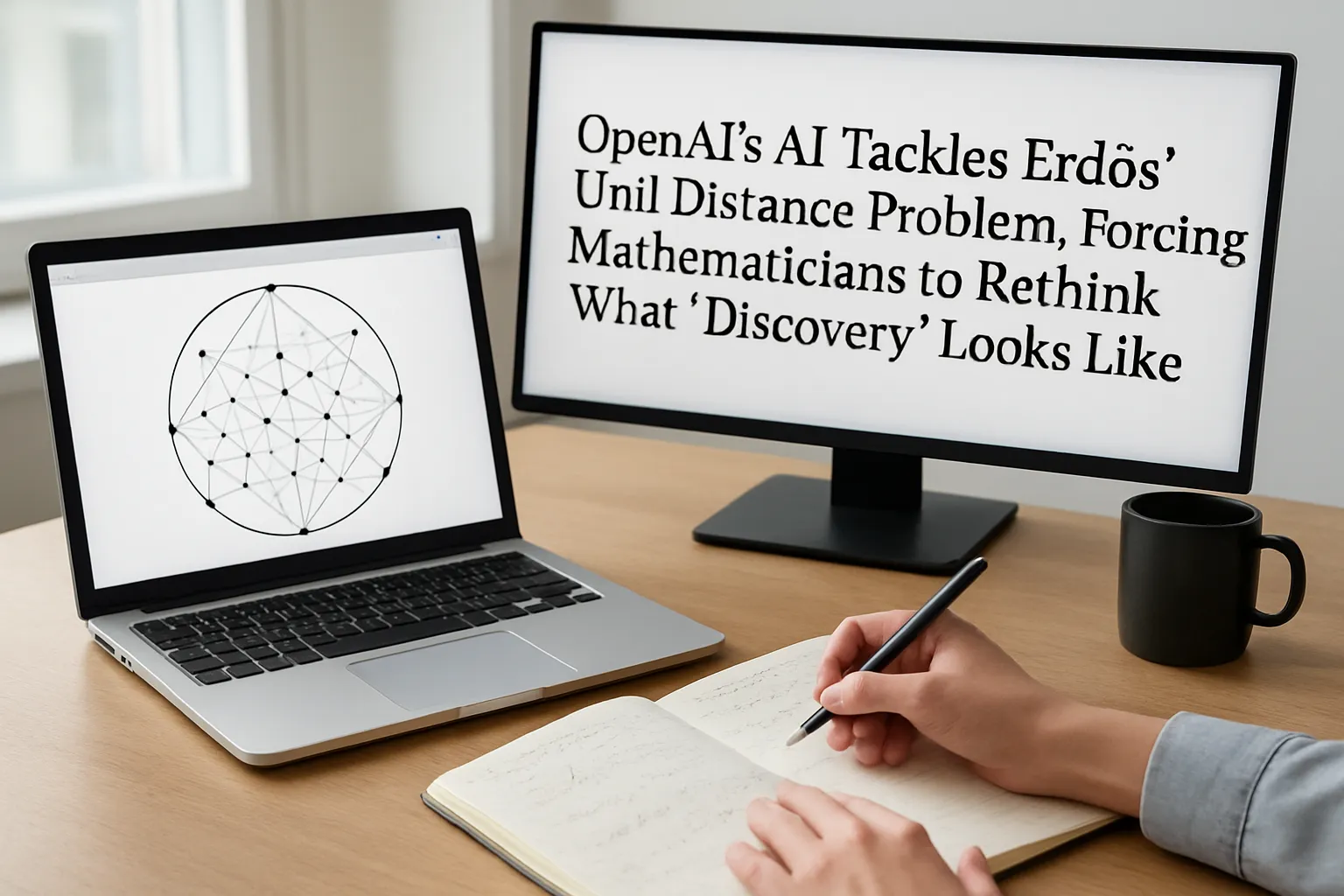
OpenAI says it has used a new large language model, GPT-5.6 Sol, to solve a math conjecture that has resisted human efforts for more than 50 years. The headline-grabbing detail isn't only the age of the problem. It's the claim that the breakthrough hinged on how the system was prompted-nudged to persist, explore, and "believe in itself."
That framing lands at a moment when AI's relationship with mathematics is changing. Language models are no longer treated purely as chatbots that explain concepts. They are being positioned as collaborators that can search proof spaces, propose lemmas, and translate intuition into formal steps-sometimes faster than a human can.
Even so, a solved conjecture is not the same thing as a solved debate. The announcement raises practical questions about what "solved" means in modern mathematics, how much of the work is creative insight versus computational grind, and what role prompting plays when the goal is a verifiable proof rather than a plausible-sounding answer.
Why a 50-year-old conjecture matters
Mathematical conjectures sit in a special category of unsolved problems. They are statements believed to be true (or false) based on partial evidence, patterns, and smaller results, but they lack a complete proof. Some conjectures are famous because they connect multiple areas of math. Others are notorious because they look simple yet resist standard techniques.
When a conjecture survives for decades, it often becomes a kind of stress test for the field. Researchers try different approaches, build partial results, and sometimes develop new tools along the way. A proof can unlock more than a single statement; it can clarify which methods work, which don't, and what the underlying structure really is.
So when OpenAI says a new model helped resolve a long-standing conjecture, the significance isn't just "AI solved a hard puzzle." It suggests that the workflow around mathematical discovery-hypothesis, exploration, proof sketching, formal verification-may be shifting toward systems that can iterate at scale.
What GPT-5.6 Sol is being positioned to do
OpenAI's description centers on GPT-5.6 Sol as a large language model capable of advanced reasoning. In the math context, "reasoning" is less about sounding coherent and more about maintaining logical constraints over long chains of inference.
Traditional language models can produce convincing mathematical prose while making subtle mistakes: a missing condition, a misapplied theorem, a step that only works in a special case. The gap between a persuasive explanation and a correct proof is wide. Closing it typically requires a combination of better internal reasoning, better search strategies, and better external checks.
The "Sol" branding also hints at specialization: a model tuned, evaluated, or scaffolded for problem solving rather than general conversation. Whether that specialization comes from training data, reinforcement learning, tool use, or a mix, the goal is the same-reduce the probability of silent logical failure.
The surprising part: prompting as a lever
The most viral takeaway from the original framing is that the system was prompted in a way that encouraged confidence and persistence. That sounds almost silly until you translate it into engineering terms.
A prompt can change how a model allocates its "effort." In practice, that can mean asking for multiple approaches, forcing explicit intermediate steps, requiring the model to check its own work, or instructing it to keep searching when it hits a dead end. "Believe in yourself" is a human-friendly shorthand for a more technical behavior: don't prematurely stop.
Math research is full of false starts. A model that quickly commits to the first plausible path may miss the route that actually works. Prompts that encourage exploration can increase the chance that the model stumbles into a useful lemma or a key transformation.
There's also a second effect. Confidence-oriented prompts can reduce hedging language and push the model to produce complete derivations instead of partial sketches. That can be helpful when the next step is verification, because a verifier needs explicit steps to check.
From "sounds right" to "is right": verification is the real bottleneck
If a model claims to have solved a conjecture, mathematicians immediately ask: where is the proof, and how is it checked? In modern workflows, there are two broad routes.
- Human review: experts read the argument, test edge cases, and look for hidden assumptions. This is slow but flexible, and it can catch conceptual errors that a purely formal checker might not flag if the statement is mis-specified.
- Formal verification: the proof is translated into a proof assistant (systems that check each logical step). This can be extremely reliable, but it requires the argument to be expressed in a strict formal language, which is often the hardest part.
Language models can help with both. They can draft proofs in human-readable form and also assist in translating steps into formal syntax. But they can also introduce errors in either mode, especially when a proof is long and depends on many definitions.
That's why the most meaningful measure of progress isn't whether a model can produce a convincing narrative. It's whether the result can be independently verified-by people, by formal tools, or ideally by both.
How AI "solves" a conjecture in practice
The public imagination often treats AI math breakthroughs as a single moment: the model outputs the final proof and the problem is done. Realistically, the process is closer to a loop.
- Problem framing: the conjecture is stated precisely, with definitions and known related results. Small ambiguities matter.
- Exploration: the model proposes approaches, tries special cases, and searches for patterns. This can include generating candidate lemmas or counterexamples.
- Proof sketching: once a promising route appears, the model attempts to connect the steps into a coherent argument.
- Checking and repair: errors are found, the model revises, and the loop repeats.
- Verification: the final argument is validated by humans and/or formal systems.
Prompting influences every stage. A prompt can demand explicit assumptions, require the model to list dependencies, or instruct it to generate multiple independent proofs and compare them. Those are not cosmetic changes; they alter the search behavior.
This is also where "believe in yourself" fits. It's a lightweight way to push the model toward longer-horizon reasoning, which is often necessary for proofs that don't yield quickly.
What this implies for mathematicians and the research pipeline
If systems like GPT-5.6 Sol can reliably contribute to proofs, the immediate impact is not that mathematicians become obsolete. It's that the bottlenecks move.
Researchers may spend less time on routine manipulations and more time on selecting the right abstractions, defining the right objects, and deciding which conjectures are worth pursuing. The "taste" part of mathematics-choosing fruitful directions-remains hard to automate.
At the same time, the pace of exploration could increase. A model can try many variants of an argument quickly, keep track of branches, and revisit earlier dead ends with new constraints. That can compress what used to be months of incremental tinkering into a shorter cycle.
There's also a cultural implication. If AI-assisted proofs become common, journals and conferences may need clearer norms about disclosure: what tools were used, how verification was performed, and what artifacts (proof scripts, logs, intermediate lemmas) are available for review.
The industry angle: math as a benchmark for trustworthy AI
Math is not just a prestige domain. It's a proving ground for reliability. A model that can handle formal reasoning is more likely to be useful in areas where mistakes are expensive: software verification, hardware design, cryptography, and safety-critical engineering.
That's why companies care about "hard math" performance. It's a proxy for whether a model can follow constraints, maintain consistency, and produce outputs that can be checked. Those are the same properties needed for writing correct code, generating secure protocols, or validating complex configurations.
Prompting, in this context, becomes part of product design. If the right instruction pattern dramatically improves outcomes, then "prompt engineering" stops being a hack and starts looking like an interface layer-one that shapes how non-experts access expert-level reasoning.
The flip side is fragility. If a breakthrough depends heavily on a particular prompt style, it raises questions about reproducibility. A robust system should succeed across a range of reasonable instructions, not only when coaxed in a very specific way.
What to watch next
OpenAI's claim about GPT-5.6 Sol solving a decades-old conjecture will inevitably trigger follow-up scrutiny: the exact statement of the conjecture, the structure of the proof, and the verification path. Those details determine whether the result becomes a durable milestone or a provocative demo.
Beyond the single conjecture, the broader story is about method. If prompting strategies can reliably push models into deeper search and more disciplined proof construction, that becomes a repeatable technique-one that other labs, researchers, and tool builders will try to replicate.
Mathematics has always advanced through new languages and new tools, from symbolic notation to computer algebra systems. AI models that can navigate both natural language intuition and formal proof constraints may end up as the next tool in that lineage. The interesting question is how quickly the surrounding ecosystem-verification, publication norms, education-adapts to match.