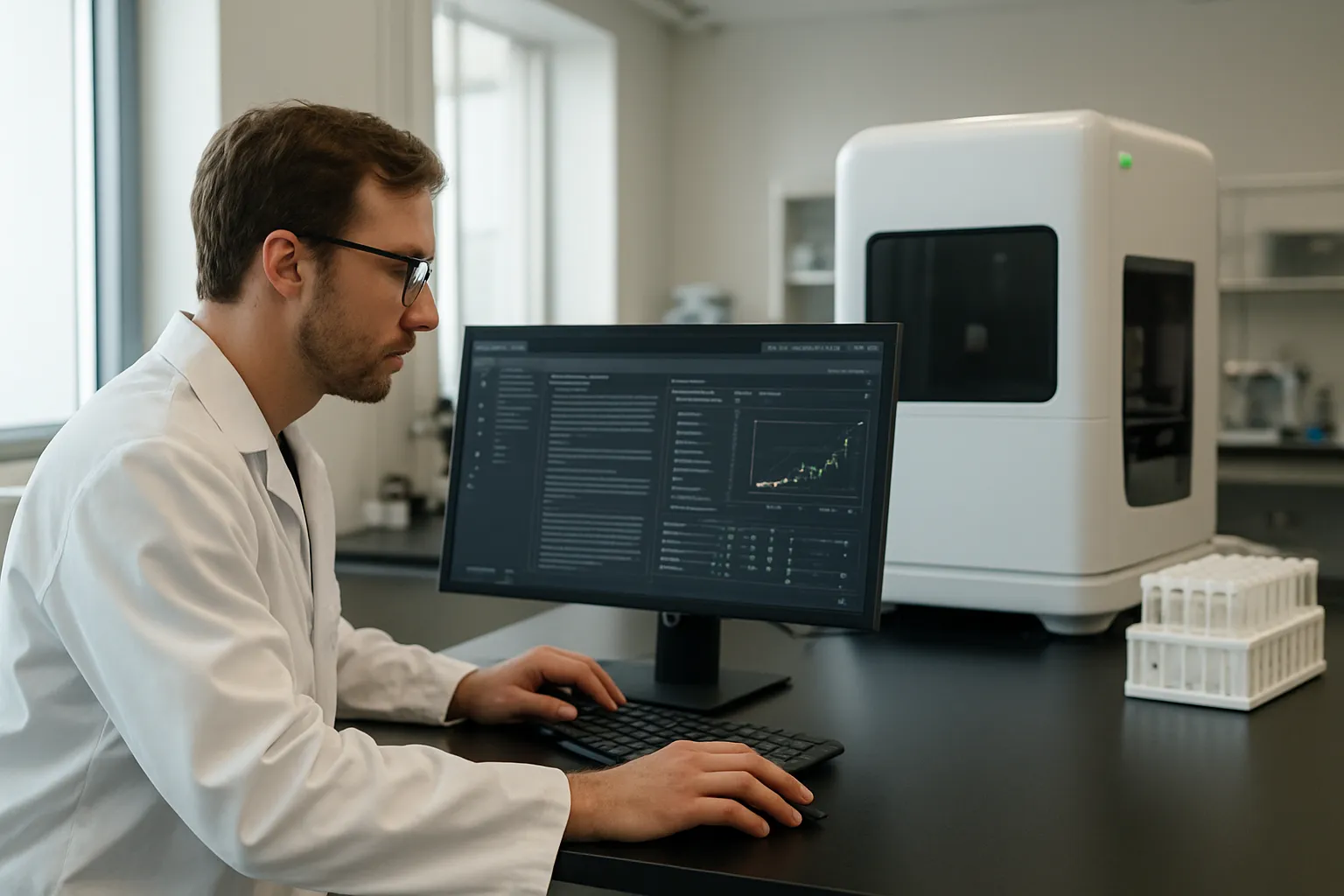
Inside a lab in Broomfield, Colorado, a quantum computer is taking shape in a way that looks more like precision physics than conventional computing. Ninety-eight individual atoms are suspended in space, pinned in place by electric fields and chilled to temperatures near absolute zero.
That setup-atoms held nearly motionless so their quantum behavior can be controlled-has now produced a result that stands out even in a fast-moving field: a new high watermark for accuracy at the 98-qubit scale. The number of qubits matters, but the quality of those qubits matters more. This machine is a reminder of that shift.
Quantum computing has spent years chasing bigger qubit counts, often with the unspoken caveat that many of those qubits are noisy and fragile. A system that can run with unusually low error rates changes the conversation. It doesn't instantly deliver a practical quantum advantage, but it tightens the link between laboratory demonstrations and useful computation.
What makes 98 trapped atoms different from 98 "qubits" on a spec sheet
A qubit is a unit of quantum information, but it isn't a standardized component like a transistor. Different quantum computers implement qubits in very different physical ways: superconducting circuits on chips, ions in electromagnetic traps, photons in optical systems, and neutral atoms arranged in arrays.
In this case, the qubits are atoms. Each atom can encode quantum information in internal energy states, and those states can be manipulated with carefully tuned electromagnetic fields and laser pulses. The atoms are isolated from many of the disturbances that plague other platforms, but they still need extreme conditions to behave predictably.
The headline number-98-signals a system large enough to be interesting, but not so large that it's automatically useful. What elevates the result is the accuracy benchmark. Quantum computing is constrained less by raw qubit count than by how long qubits stay coherent and how reliably operations can be performed without introducing errors.
Accuracy is the real bottleneck
Quantum computers are error-prone by nature. Qubits interact with their environment, and that interaction causes decoherence-loss of the delicate quantum state that computation depends on. Even when qubits remain coherent, the operations used to control them can introduce mistakes.
Those errors compound quickly. A quantum algorithm is typically a long sequence of operations (often called gates), and each operation has some probability of error. If the error rate is too high, the final result becomes meaningless long before the algorithm finishes.
That's why accuracy benchmarks are watched so closely. They indicate whether a platform is moving toward the threshold where error correction becomes practical. Quantum error correction doesn't eliminate errors by making hardware perfect; it uses redundancy-many physical qubits to represent one logical qubit-so the system can detect and correct mistakes as it runs. The catch is that error correction only works if the underlying hardware is already good enough.
How trapped-atom systems aim for cleaner qubits
Trapping atoms in mid-air sounds like science fiction, but the underlying idea is straightforward: isolate the qubits from noise and control them with precision. Electric fields can confine charged particles directly, but neutral atoms require different techniques, often involving optical or electromagnetic trapping methods that create "wells" where atoms sit.
Cooling the atoms to near absolute zero reduces thermal motion. Less motion means the atoms stay where they're supposed to be, and their quantum states are less likely to be disturbed. That stability helps with repeatability, which is essential for running the same quantum program many times to build confidence in the output.
The other challenge is making qubits interact on command. Quantum computation requires entanglement-correlations between qubits that have no classical equivalent. In atom-based systems, entanglement can be created by driving the atoms into specific excited states and using controlled interactions. The details vary by implementation, but the goal is the same: strong, controllable coupling when you want it, and isolation when you don't.
Benchmarks: what they do-and don't-tell you
When a quantum computer sets an accuracy record, it's tempting to treat it as a direct measure of "how powerful" the machine is. In practice, benchmarks are proxies. They measure how faithfully a device can implement certain operations or circuits, and how quickly errors accumulate.
A high-accuracy result at 98 qubits suggests the system can run deeper circuits-more steps-before noise overwhelms the computation. That matters because many useful algorithms require depth, not just width. A device with many qubits but high error rates may only be able to run shallow circuits that don't outperform classical methods.
At the same time, benchmarks don't automatically translate into real-world advantage. Useful quantum applications depend on a mix of factors: the algorithm, the mapping of that algorithm to the hardware, the ability to read out results accurately, and the overhead of error mitigation or correction. A record is a signpost, not a finish line.
Why "near-term" quantum computing keeps circling back to chemistry and materials
The most frequently discussed near-term applications for quantum computers involve simulating quantum systems-because nature itself is quantum. Modeling molecules, catalysts, and materials at high fidelity is notoriously hard for classical computers as systems grow in complexity.
A more accurate 98-qubit machine could be relevant here because many simulation approaches rely on executing circuits that are sensitive to noise. Better accuracy can reduce the amount of error mitigation required, which in turn can make experiments more interpretable.
Still, the gap between a lab demonstration and a tool that reliably helps chemists or materials scientists remains wide. The industry has learned that "more qubits" alone doesn't close that gap. Hardware quality, calibration, and software tooling matter just as much.
The industry shift: from qubit counts to engineering discipline
Quantum computing is increasingly being judged like an engineering field rather than a physics showcase. That means repeatability, uptime, calibration workflows, and the ability to scale manufacturing and control systems. A trapped-atom approach adds its own engineering demands: ultra-high vacuum systems, stable lasers, precise electromagnetic control, and careful thermal management.
Accuracy milestones are often a reflection of that engineering discipline. They imply improvements in how qubits are prepared, how operations are executed, and how noise sources are identified and suppressed. They also suggest progress in control electronics and software that orchestrate the system.
This is where the broader ecosystem comes in. Quantum hardware doesn't exist in isolation; it depends on classical computing for control, compilation, and error analysis. Better quantum accuracy can reduce the classical overhead required to compensate for noise, which can make the entire stack more efficient.
What this could mean for error correction timelines
Error correction is the gateway to large-scale, fault-tolerant quantum computing. The field has long known the basic theory, but the practical requirements are steep. You need physical qubits with low error rates, fast and reliable measurements, and the ability to perform correction cycles repeatedly without introducing more errors than you remove.
A 98-qubit system that demonstrates unusually high accuracy strengthens the case that some platforms are approaching the regime where small logical qubits become feasible. That doesn't mean a general-purpose fault-tolerant machine is imminent. It does mean the path looks less speculative than it did when error rates were the dominant story.
The next steps typically involve scaling while preserving performance. Many quantum platforms show strong results at small sizes, then struggle as complexity grows. Maintaining accuracy as qubit count increases is one of the hardest problems in the field.
Why this matters even if you never run code on it
Most people won't interact directly with a trapped-atom quantum computer, and even many researchers will access quantum hardware through cloud interfaces rather than in person. The practical impact of a new accuracy benchmark is indirect: it influences which approaches attract investment, which partnerships form, and which roadmaps look credible.
It also shapes expectations. The public narrative around quantum computing has oscillated between hype and skepticism, often driven by qubit counts that don't reflect real capability. Accuracy-focused milestones help ground the discussion in what actually determines progress.
For enterprises watching the space, the message is nuanced. A high-accuracy 98-qubit machine doesn't automatically unlock a commercial breakthrough, but it does suggest that the hardware base is maturing. That can change how organizations think about pilot projects, talent development, and long-term planning.
The next questions researchers will ask
After an accuracy milestone, attention usually turns to a few practical tests. Can the system maintain performance over long runs, not just in carefully curated demonstrations? How quickly can it be recalibrated? How stable is it day to day?
Researchers will also look at how the machine handles more complex circuits and whether its error characteristics are well understood. Some errors are random; others are systematic and can be harder to eliminate. Understanding that difference is key to improving performance and to designing error correction schemes that fit the hardware.
Finally, there's the scaling question. If 98 atoms can be controlled with high accuracy, what happens at 200, 500, or 1,000? The answer will depend not only on physics but on the engineering of control systems, the ability to manage crosstalk and noise, and the practicality of operating larger arrays reliably.