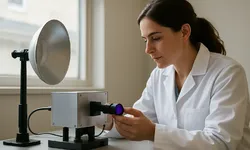
Turning low-energy sunlight into higher-energy ultraviolet (UV) light sounds like a trick that should violate common sense. In everyday terms, it resembles combining two cups of warm water and ending up with boiling water-an outcome that feels impossible without adding extra heat.
Yet quantum physics allows a close cousin of that idea: under the right conditions, a material can absorb multiple lower-energy photons and emit a single photon with higher energy. Researchers have now demonstrated a new solid-state material that can do this using sunlight, producing UV light from visible wavelengths. The result tackles a problem that has held back "sunlight-to-UV" conversion for years and could broaden what solar energy can do beyond electricity.
If the approach scales, it could enable sunlight-driven air purification, cleaner chemical synthesis, and manufacturing processes that currently rely on UV lamps and the electricity that powers them.
Why UV matters-and why it's hard to get from the Sun
UV light plays an outsized role in chemistry and materials processing. It can break chemical bonds, generate reactive species, and trigger photochemical reactions that visible light cannot. That's why UV is used in applications ranging from disinfection and pollutant breakdown to polymer curing and microfabrication.
The challenge is that UV photons carry more energy than visible photons. Sunlight at Earth's surface contains some UV, but much of the most energetic UV is filtered by the atmosphere. For many industrial and environmental uses, the available UV intensity is not enough, so systems rely on artificial UV sources.
Those sources-often mercury-based lamps or UV LEDs-add cost, complexity, and energy demand. A material that can take abundant visible sunlight and "upgrade" it into UV could shift that equation, especially for outdoor or off-grid processes.
The quantum trick: upconversion in a solid
The underlying phenomenon is generally known as photon upconversion. Instead of emitting light at the same or lower energy than what it absorbs (as in typical fluorescence), an upconverting system combines energy from multiple absorbed photons to emit one photon at higher energy.
There are several ways to do this in principle, but many practical demonstrations have depended on carefully tuned lasers, cryogenic temperatures, or liquid-phase mixtures that are difficult to integrate into real devices. Sunlight is broadband and relatively low intensity compared with lasers, and that makes the "energy combining" step much harder.
Solid-state upconversion is especially attractive because solids can be made into coatings, films, and device layers. But solids also introduce their own obstacles: molecules can pack too closely, energy can be lost as heat, and excited states can be quenched by defects or oxygen. The new work addresses a long-standing frustration in getting a solid material to perform this conversion efficiently under sunlight-like conditions.
What makes sunlight-powered upconversion difficult
To understand why this has been such a stubborn problem, it helps to look at the bottlenecks that typically appear when researchers try to move upconversion from a lab demonstration to something that works under the Sun.
- Low photon density: Many upconversion pathways require two excitations to meet within a short time window. Lasers provide a flood of photons; sunlight does not.
- Competing loss channels: Excited states can relax without producing useful emission, dumping energy as heat or transferring it to impurities.
- Oxygen sensitivity: Some mechanisms rely on long-lived excited states that oxygen can quench, which is a major issue for real-world operation.
- Solid-state packing problems: In solids, molecules can interact in ways that encourage non-radiative decay, reducing the chance of emitting a higher-energy photon.
A material that can overcome several of these issues at once-while remaining stable and manufacturable-would be a meaningful step toward practical solar-to-UV systems.
What a solid-state sunlight-to-UV material could enable
The immediate appeal of converting visible sunlight into UV is that it could provide UV photons without plugging in a lamp. That sounds simple, but it changes the design space for a range of technologies.
Air purification and environmental remediation
Many air-cleaning and water-treatment approaches use UV to generate reactive species that can break down pollutants. UV can also activate photocatalysts-materials that use light to drive chemical reactions on their surfaces.
If a solid coating can generate UV from sunlight, it could be paired with photocatalytic materials to enhance pollutant breakdown outdoors or in sunlit environments. The promise is not just "more UV," but UV delivered exactly where a catalyst sits, potentially reducing the need for powered reactors.
Solar-driven chemistry
Photochemistry is a powerful tool for making and modifying molecules, but many reactions require UV to reach the right excited states or to cleave specific bonds. That requirement is one reason photochemical manufacturing often depends on specialized lamps.
A sunlight-to-UV layer could act as a spectral "translator," allowing reactors designed for sunlight to access UV-driven reaction pathways. That could broaden the set of chemical transformations that can be attempted with solar input, especially for distributed or lower-infrastructure settings.
Advanced manufacturing and materials processing
UV is central to curing coatings, adhesives, and resins. It is also used in patterning and surface treatments. These processes are typically engineered around controlled UV sources for consistency and speed.
A sunlight-powered UV source is unlikely to replace factory UV systems overnight, because manufacturing values repeatability. But it could enable new workflows where portability matters-field repairs, outdoor curing, or hybrid systems that reduce electrical load when sunlight is available.
How this differs from familiar solar technologies
Most solar innovation headlines focus on photovoltaics-turning sunlight into electricity-or on solar thermal systems that turn sunlight into heat. Photon upconversion sits in a different category: it reshapes the spectrum of light itself.
That distinction matters because many technologies are limited not by the amount of solar energy available, but by the wavelength they need. A catalyst might only respond to UV. A polymer might only cure under UV. A reaction might proceed cleanly only when driven by higher-energy photons.
Spectral conversion materials aim to bridge that mismatch. Some approaches shift light down in energy (for example, converting UV to visible to better match a solar cell). Upconversion goes the other way, and that is why it has been so difficult to do efficiently under sunlight.
Integration questions: coatings, films, and device layers
A key advantage of a solid-state material is that it can, in principle, be integrated into real products. That could mean a thin film on glass, a coating on a reactor wall, or a layer laminated onto another functional surface.
But integration raises practical questions that will determine whether the breakthrough becomes a platform technology or remains a specialized lab material:
- Optical coupling: How much visible light can the layer absorb without blocking too much of the spectrum needed by other components?
- UV extraction: Can the generated UV escape the material efficiently, or is it reabsorbed and lost?
- Durability: UV can degrade many materials, including the very layers that generate it. Long-term stability will be central.
- Manufacturability: Can the material be produced as large-area films or coatings with consistent performance?
Even without specific performance numbers, the direction is clear: the closer the material gets to "paintable" or "coatable," the more likely it is to find early applications in environmental and chemical systems.
Industry implications: a new kind of solar component
If sunlight-to-UV conversion becomes practical, it could create a new class of solar-adjacent components. Instead of competing with solar panels, these materials would complement them, enabling systems that use sunlight as a direct chemical input.
That could matter for sectors that are hard to electrify or where electricity is not the most efficient intermediate. Chemical processing, remediation, and certain manufacturing steps often care about photons, not electrons. A material that supplies the right photons from sunlight could reduce reliance on grid power in targeted processes.
It could also influence how companies think about outdoor infrastructure. Surfaces that passively generate UV under sunlight could be integrated into building materials, filtration systems, or modular reactors-provided safety and stability concerns are addressed.
Safety and control: UV is useful, but not benign
Any technology that increases UV availability has to contend with safety. UV can damage skin and eyes, and it can degrade plastics and coatings. That doesn't rule out sunlight-to-UV materials, but it shapes where and how they can be deployed.
Practical systems would likely need to confine UV generation to enclosed reactors, shielded ducts, or surfaces designed to minimize human exposure. Control also matters: industrial processes often require consistent dosing, while sunlight varies with weather and time of day.
These constraints suggest early adoption may happen in contained environments-air and water treatment modules, sealed photochemical reactors, or specialized manufacturing tools-before any broader architectural use is considered.
What to watch next
A lab demonstration is the start of a longer path. For sunlight-powered upconversion to become a practical tool, researchers and potential commercial partners will likely focus on a few themes: improving efficiency under real sunlight, maintaining performance over long periods, and integrating the material into scalable form factors.
Another open question is how broadly the approach can be tuned. UV is a range, not a single wavelength, and different applications want different parts of the UV spectrum. Materials that can be engineered to emit at specific UV energies-or that can be paired with catalysts optimized for the emitted light-would be more versatile.
For now, the headline is simple: a solid-state material has shown it can use sunlight to generate higher-energy UV light, clearing a hurdle that has limited the field. The more interesting story will be where that UV ends up being used first-on a catalyst, in a reactor, or in a manufacturing line that no longer needs to keep its UV lamps on all day.