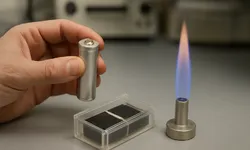
Thermal runaway is the battery industry's nightmare scenario: a chain reaction where heat triggers chemical breakdown, which releases more heat, which accelerates the breakdown. Once it starts, it can be difficult to stop, especially in tightly packed modules like those used in electric vehicles, grid storage, and consumer electronics.
Battery makers already throw a lot at the problem-careful materials selection, manufacturing controls, sensors, venting strategies, and pack-level barriers meant to keep a single failing cell from taking its neighbors with it. A new proposal from researchers at the Chinese Academy of Sciences takes a different angle: instead of only trying to contain failure from the outside, build a "firewall" inside the cell that forms when temperatures rise.
The idea is simple to describe and hard to execute: engineer the battery so that, under abnormal heat, it creates an internal layer that slows or blocks the processes that drive runaway. If it works at scale, it could add a new line of defense in a field where redundancy is the point.
Why thermal runaway is so hard to manage
Lithium-ion batteries store energy in chemical form, and the same chemistry that makes them compact and powerful can become unstable when pushed beyond safe limits. Overcharging, internal short circuits, physical damage, manufacturing defects, or exposure to external fire can all raise temperatures inside a cell.
As heat builds, components inside the battery begin to decompose. The electrolyte can break down, electrodes can react with the electrolyte, and the separator-an internal membrane that keeps the electrodes apart-can shrink or fail. Those reactions release heat and gases, increasing pressure and temperature further. That feedback loop is what turns a localized fault into a self-sustaining event.
Pack designers try to prevent the initial trigger and also limit propagation. But the industry has learned that "prevent" and "contain" are not the same thing. A cell-level event can still occur, and if it does, the question becomes whether it stays local long enough for sensors, vents, and thermal barriers to do their jobs.
The internal firewall concept
The Chinese Academy of Sciences team is proposing a cell that can generate its own protective barrier when exposed to high temperatures. The "firewall" framing is a metaphor, but it captures the intent: create an internal structure that interrupts heat transfer and/or blocks the chemical pathways that accelerate failure.
Traditional safety features tend to be passive and fixed: separators with shutdown behavior, current interrupt devices, vents, and external insulation. An internal firewall is more dynamic. It is meant to appear when conditions become dangerous, rather than existing as a constant trade-off against performance.
That distinction matters because battery engineering is full of compromises. Adding thicker separators, more robust casings, or extra thermal barriers can improve safety but often reduces energy density, increases cost, or complicates manufacturing. A mechanism that activates only under abnormal conditions aims to minimize those everyday penalties.
How a battery can "build" a barrier under heat
A lithium-ion cell is a layered system: current collectors, porous electrodes, separator, and electrolyte. Heat moves through those layers, and reactions occur at interfaces. To create an internal firewall, a designer has to manipulate one or more of those layers so that, at a threshold temperature, the cell's internal structure changes in a predictable way.
There are several broad strategies researchers explore in this area:
- Thermally triggered phase changes that turn a component into a more insulating or less reactive form.
- Heat-activated additives that scavenge reactive species or suppress flammable decomposition products.
- Self-forming interfacial layers that slow ion transport or block direct contact between reactive surfaces when temperatures spike.
- Structural transformations that reduce internal shorting risk or limit oxygen release from certain cathode materials.
The internal firewall idea fits within this family of "smart" safety mechanisms. The key is that the response must be fast, reliable, and repeatable. It also has to be compatible with the rest of the cell chemistry and manufacturing process.
Why cell-level safety is attractive to manufacturers
Pack-level safety has improved dramatically, but it is also where cost and complexity accumulate. Sensors, cooling plates, thermal interface materials, fire-resistant barriers, and mechanical isolation all add weight and volume. They also create more parts that must be validated and more failure modes to consider.
If a cell can better manage its own worst-case behavior, pack designers can potentially simplify some of those layers. That does not mean removing safety systems-regulators and automakers tend to prefer multiple independent protections-but it could change how those systems are sized and where the emphasis goes.
There is also a supply chain angle. Cell-level improvements can be adopted by multiple downstream customers without requiring each customer to redesign an entire pack architecture. That makes the cell itself a more differentiated product, not just a commodity defined by capacity and cycle life.
The engineering challenges hiding behind the headline
A "fireproof battery" is a catchy phrase, but batteries are complex electrochemical devices, not inert blocks. Any new internal mechanism has to survive the realities of production and use.
Manufacturability is the first hurdle. Battery factories run at enormous scale, with tight tolerances and high throughput. A design that requires exotic materials, difficult coating steps, or narrow process windows may struggle to move beyond the lab.
Compatibility is next. The internal firewall must not degrade normal performance. It cannot introduce impurities that shorten cycle life, increase impedance, or cause gas generation during routine charging. It also must not interfere with the formation process, the early-life conditioning step that helps build stable interfacial layers.
Trigger precision is another issue. If the firewall activates too early, it could reduce power output or permanently damage the cell during benign temperature excursions. If it activates too late, it may not stop runaway. The activation temperature and response speed have to be tuned to real-world abuse scenarios.
Testing and validation may be the hardest part. Thermal runaway is stochastic; small differences in defects, state of charge, and mechanical stress can change outcomes. Demonstrating that a new safety mechanism works across cell formats, chemistries, and aging conditions requires extensive abuse testing and careful interpretation.
What "internal firewall" could mean for EVs and grid storage
Electric vehicles concentrate energy in a confined space, often near passengers, and they experience vibration, impacts, and wide temperature swings. Automakers already design packs with propagation resistance in mind, but they also face pressure to increase range and reduce cost. A cell that can better resist runaway or slow propagation could help balance those competing demands.
Grid storage has a different profile. Systems are stationary, but they can be deployed in large arrays, sometimes in containers. A single event can threaten adjacent racks, and the consequences can include long outages and difficult firefighting conditions. Technologies that reduce the likelihood of runaway or slow its progression can be valuable even if they add modest cost, because the system-level risk is high.
Consumer electronics sits somewhere in between. Space is limited, and devices are used in unpredictable environments. Cell-level safety improvements are attractive because they do not require bulky external barriers, but they must be compatible with thin form factors and high-volume manufacturing.
How this fits into the broader battery safety toolkit
Battery safety is rarely solved by a single breakthrough. It is built from layers:
- Materials choices that reduce oxygen release, lower flammability, or improve thermal stability.
- Cell design features like shutdown separators, vents, and current interrupt devices.
- Battery management systems that monitor voltage, current, and temperature to prevent abuse conditions.
- Mechanical and thermal pack design to isolate cells and manage heat.
- Manufacturing quality control to reduce defects that can lead to internal shorts.
An internal firewall would be another layer, aimed at the moment when prevention has failed and the cell is heading toward a dangerous temperature regime. The most realistic impact is not making batteries "fireproof" in an absolute sense, but improving the odds that a fault remains contained, buying time for other protections to work.
Industry implications: safety as a performance metric
Energy density and cost per kilowatt-hour dominate battery headlines, but safety increasingly shapes purchasing decisions and regulatory scrutiny. For automakers, a battery's behavior under abuse can influence pack architecture, warranty assumptions, and even vehicle design. For utilities, it can affect site permitting, insurance, and emergency response planning.
If internal-firewall-style designs mature, they could shift how cell suppliers compete. Safety would become more quantifiable as a differentiator, not just a baseline requirement. That could also influence standards and test protocols, pushing the industry to evaluate not only whether a cell fails under extreme conditions, but how it fails and how quickly it escalates.
There is also a messaging challenge. Terms like "fireproof" can be misunderstood by consumers and policymakers. The practical goal is risk reduction and propagation resistance, not a guarantee that a battery cannot burn under any circumstance. Clearer language and standardized metrics would help keep expectations aligned with engineering reality.
What to watch next
The research proposal from the Chinese Academy of Sciences points to a direction battery safety research is moving: adaptive, internal mechanisms that respond to heat before runaway becomes unstoppable. The next questions are about translation from lab to factory and from single-cell demonstrations to multi-cell packs.
Key milestones to watch include whether the approach can be integrated into common cell formats, whether it remains effective after aging, and how it performs across different states of charge. Equally important is whether it can be produced with the consistency that modern battery supply chains demand.
Thermal runaway may never be eliminated entirely, but the industry keeps finding ways to narrow the window where a fault turns into a catastrophe. An internal firewall is an ambitious addition to that playbook.