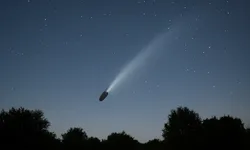
When 1I/‘Oumuamua flashed through the inner solar system in 2017, it arrived with a built-in puzzle. The object followed a hyperbolic path that marked it as interstellar, yet it also showed a small extra push-an acceleration that didn't match gravity alone.
Comets often do that. As sunlight warms their surfaces, escaping gas acts like a thruster. The problem was that ‘Oumuamua didn't look like a comet. Telescopes saw no obvious coma, no bright tail, and no dust cloud that would normally accompany strong outgassing.
Now astronomers are paying closer attention to a strange population sometimes described as "dark" comets: objects that can behave dynamically like comets while looking, at least at first glance, more like asteroids. Some of them appear to sprout tails only under certain conditions. If that behavior is common, it could offer a more grounded way to think about ‘Oumuamua's oddities-and it could also change how researchers model the movement of water and other volatiles through young planetary systems.
The ‘Oumuamua problem: acceleration without a comet's signature
The core of the ‘Oumuamua debate has never been whether it was interstellar. Its speed and trajectory made that clear. The controversy centered on what it was made of and why it deviated slightly from the path predicted by gravity.
Non-gravitational acceleration is common in small bodies. For comets, jets of gas and dust provide the explanation. For asteroids, such acceleration can come from subtler effects like uneven thermal radiation (the Yarkovsky effect), but the magnitude and timing of ‘Oumuamua's acceleration pushed many researchers back toward outgassing as the simplest mechanism.
Yet outgassing usually leaves fingerprints. Gas can fluoresce, dust reflects sunlight, and both can create a visible coma. The absence of those signatures forced scientists into uncomfortable corners: either the outgassing was happening in an unusual way, or the object's surface and composition were unlike familiar solar system bodies.
What "dark comets" are-and why they matter
"Dark comet" is a shorthand for objects that occupy a gray zone between comet and asteroid. They can travel on orbits typical of comets and show subtle non-gravitational forces consistent with outgassing, but they may not display the bright, obvious activity that makes a comet easy to spot.
Some may be coated in insulating material that suppresses visible dust release. Others might vent mostly gas with little dust, producing weaker optical signatures. In some cases, activity could be intermittent-triggered only when the object reaches a particular temperature range, when sunlight hits a volatile-rich patch, or when the surface fractures and exposes fresh ice.
The "dark" label is less about literal color and more about detectability. If an object releases gas but not much dust, it can remain faint and star-like in images. That makes it easy to catalog as an asteroid unless someone measures its motion precisely enough to notice the tiny extra acceleration.
How a tail can appear late-or not at all
A classic comet tail is often dust-driven: sunlight pushes small grains away from the nucleus, and the dust reflects light efficiently. Gas tails exist too, but they can be harder to see without the right filters and instruments.
A "dark" comet could, in principle, outgas in a way that produces thrust without producing much visible dust. If the escaping material is dominated by transparent or weakly scattering molecules, or if the dust grains are larger and fewer, the object might accelerate while still looking like a point of light.
Another possibility is timing. Activity can ramp up quickly if a surface layer fails. A crust of refractory material can trap volatiles beneath it. When pressure builds or thermal stress cracks the surface, a sudden vent can release gas and dust, briefly producing a tail that wasn't there earlier.
That kind of on-and-off behavior matters because it changes what observers should expect. A lack of a tail at one moment doesn't guarantee a lack of outgassing overall. It may simply mean the object is in a quiet phase, or that the activity is happening in a way that is observationally subtle.
A more ordinary explanation for an extraordinary visitor
‘Oumuamua inspired a wide range of hypotheses, from exotic natural scenarios to more speculative ideas. The reason those discussions took off is that the object was both fleeting and unfamiliar. It was discovered after it had already passed closest approach to the Sun, leaving limited time to gather data.
The appeal of "dark comets" is that they offer a bridge between what astronomers already know and what ‘Oumuamua seemed to demand. If a population of objects can accelerate due to outgassing while remaining visually quiet, then ‘Oumuamua's behavior becomes less singular.
That doesn't automatically solve every aspect of the interstellar visitor. Shape, rotation, surface properties, and the details of the acceleration still matter. But it narrows the gap between "comet-like physics" and "asteroid-like appearance," which is where much of the mystery has lived.
Why these objects are hard to find in our own solar system
Astronomy has long relied on appearance-based classification. If a small body shows a coma or tail, it's a comet. If it looks like a point source and follows a stable orbit, it's an asteroid. "Dark comets" challenge that workflow.
To identify a comet that doesn't look like one, researchers need precise tracking over time. They must model the object's orbit and look for tiny deviations that can't be explained by gravitational interactions alone. That requires repeated observations, careful calibration, and enough time to see a pattern.
Even then, non-gravitational forces can be subtle. Solar radiation pressure can mimic some effects for very small or unusually shaped bodies. Thermal forces can also shift orbits. Untangling those contributions is difficult, and it becomes even harder when the object is faint or only briefly observable.
The interstellar angle: what gets ejected from other systems
Interstellar objects are expected to be common in the galaxy, even if they are hard to detect. Planet formation is messy. Young systems contain swarms of small bodies, and gravitational interactions with growing planets can fling debris outward. Over time, those ejected objects become free-floating travelers between stars.
If "dark comets" are real and numerous, they may represent a particular kind of ejecta: volatile-bearing bodies that have developed insulating surfaces or unusual activity patterns. That would affect expectations for what interstellar visitors should look like when they pass through our neighborhood.
It also changes the observational strategy. If many interstellar objects are not bright, dusty comets, then surveys that rely on obvious cometary activity may miss a large fraction of them. The next ‘Oumuamua-like discovery could be hiding among objects initially tagged as asteroids.
A link to habitability: moving water and organics around
The original excitement around comets and habitability comes from their chemistry. Comets and other icy bodies can carry water, carbon-bearing compounds, and other volatiles that are important for building atmospheres and, potentially, prebiotic chemistry.
Earth's early history involved intense mixing and impacts. One long-running question is how much of Earth's water and volatile inventory was delivered by small bodies versus retained from the planet's formation. The answer likely involves multiple sources, including asteroids and comets, and depends on the timing and dynamics of the early solar system.
A population of "dark" comets complicates the accounting. If some volatile-rich bodies masquerade as asteroids, then the boundary between "dry" and "icy" populations becomes less clean. That matters for models of how volatiles are transported inward from colder regions where ices can survive.
What would confirm the idea?
The strongest case for "dark comets" comes from combining dynamical evidence with direct signs of activity. That can include faint comae detected with deep imaging, gas emission lines seen with spectroscopy, or changes in brightness that match episodic venting.
Another route is population studies. If many objects on comet-like orbits show consistent non-gravitational accelerations without obvious dust, that would suggest the phenomenon is not rare. It would also help constrain how much mass loss is required to produce the observed orbital changes.
For interstellar objects, confirmation is harder because they move fast and are discovered late. The best opportunity will come from earlier detection and rapid follow-up across wavelengths, including infrared observations that can reveal warm dust and spectroscopy that can catch faint gas signatures.
Implications for the next generation of sky surveys
The practical takeaway is that classification may need to become more dynamic. Instead of sorting objects into comet or asteroid bins based on appearance alone, surveys and follow-up programs may increasingly rely on orbital behavior and subtle physical cues.
That shift would also influence how astronomers prioritize targets. An object that looks inert but shows a small, persistent acceleration could become a high-value candidate for deeper observation. The same goes for bodies that suddenly develop tails after appearing quiet, which could indicate volatile reservoirs beneath the surface.
If "dark comets" help explain ‘Oumuamua, they do so by making the strange a little more familiar. They suggest that the solar system may already contain objects that behave like the interstellar visitor did-just not in ways that are easy to see at first glance.