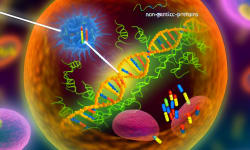
Recent advances in synthetic biology have been limited by the traditional role of DNA as the cell’s genetic material. However, a pioneering study has demonstrated the construction of synthetic, non-genetic DNA systems capable of sequence-specific protein binding within living cells. By engineering retron-derived small DNAs, researchers have created a platform for programmable DNA–protein interactions that function independently of the cell’s genome.
This innovative approach leverages the unique properties of retron-derived DNA, allowing scientists to design and introduce small DNA molecules that bind to target proteins with high specificity. Unlike conventional genetic engineering, these synthetic DNAs do not integrate into the genome, minimizing risks associated with genetic modification and enabling reversible, tunable control over protein functions.
Applications of this technology are vast, ranging from the development of novel biosensors and targeted therapeutics to advanced cellular reprogramming. The system’s flexibility is further enhanced by a plasmid platform with adjustable copy numbers, as described by Rouches et al. (2022), enabling precise modulation of synthetic DNA concentrations within cells.
This breakthrough not only expands the design space for synthetic DNA–protein systems but also sets the stage for next-generation tools in biotechnology, medicine, and synthetic biology. The ability to engineer non-genetic DNA for sequence-specific protein binding represents a significant leap forward in our capacity to manipulate cellular processes safely and efficiently.
Read the source »