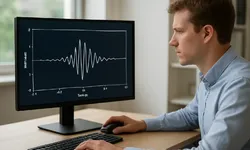
Gravitational-wave astronomy has a habit of turning tidy theories into messy, interesting questions. A recent signal detected by LIGO has done exactly that, prompting researchers at the University of Miami to argue that the event may not fit comfortably into the usual catalog of black hole and neutron star mergers.
Their interpretation points toward a long-discussed but still unconfirmed possibility: primordial black holes, hypothetical objects that could have formed in the earliest moments of the universe. If such black holes exist in meaningful numbers, they have been proposed as a candidate for at least some portion of dark matter-an invisible component that appears to dominate the universe's mass budget but has resisted direct detection.
The claim is not that dark matter has been solved overnight. It is that an odd gravitational-wave signature may be the kind of clue that forces the field to take primordial black holes seriously again, not as a purely theoretical curiosity but as something that could be tested with data.
What makes a LIGO signal "strange"
LIGO detects gravitational waves by measuring tiny changes in the lengths of kilometer-scale interferometer arms as a wave passes through Earth. The signals it sees are not images; they are time-series patterns that encode the masses and spins of the merging objects, the shape of the orbit, and how far away the event likely occurred.
Most detections so far have been consistent with mergers of stellar-mass black holes, and a smaller number involve neutron stars. These events produce a characteristic "chirp": the frequency and amplitude rise as the objects spiral inward, followed by a ringdown as the final merged object settles.
An event becomes "unusual" when the inferred parameters sit in awkward territory-masses that are hard to produce through known stellar evolution channels, spins that look unexpected, or a waveform that suggests an atypical formation history. Researchers can also flag a signal as odd when it seems to imply a merger between objects that are difficult to classify cleanly as either neutron stars or black holes.
The University of Miami team's interest centers on the idea that the signal could be better explained if at least one of the merging objects was primordial rather than the endpoint of a star's life. That is a bold interpretation, but it is also the kind of hypothesis gravitational-wave data can, in principle, pressure-test.
Primordial black holes: the early-universe alternative
Black holes are usually introduced as stellar remnants: massive stars exhaust their fuel, collapse, and leave behind a compact object. Primordial black holes, by contrast, are proposed to form from extreme density fluctuations in the early universe, long before the first stars.
The underlying concept is straightforward. If, in the hot, dense early cosmos, some regions were slightly overdense compared with their surroundings, gravity could overwhelm pressure and expansion locally, causing collapse into a black hole. The masses of such black holes would depend on when they formed; earlier formation generally corresponds to smaller horizon scales and potentially smaller black holes, while later formation could yield larger ones.
That origin story matters because it bypasses the astrophysical constraints of star formation, stellar lifetimes, and chemical composition. A primordial population could, in theory, include black holes in mass ranges that are rare or difficult to produce through ordinary stellar evolution.
For decades, primordial black holes have lived in a liminal space: plausible enough to be studied, elusive enough to remain unconfirmed. Gravitational-wave detections offer a new way to look for them, because mergers provide a direct probe of compact objects regardless of whether they emit light.
Why dark matter keeps pulling the conversation back
Dark matter is inferred from its gravitational effects. Galaxies rotate too fast for the visible matter they contain, galaxy clusters show extra mass through gravitational lensing, and the large-scale structure of the universe grows in a way that suggests an additional, non-luminous component.
The leading view in particle physics has long been that dark matter is made of new particles that rarely interact with ordinary matter. Yet decades of searches have not produced a definitive detection. That gap has kept alternative ideas alive, including the possibility that at least some dark matter could be made of compact objects.
Primordial black holes are attractive in this context because they would be "dark" by nature and interact primarily through gravity. If they exist in the right abundance and mass range, they could contribute to the missing mass without requiring new particle species.
The challenge is that the universe provides many ways to rule out too many primordial black holes. Their gravitational influence would leave signatures in lensing surveys, the cosmic microwave background, and the dynamics of stars and galaxies. The remaining allowed parameter space is narrower than early enthusiasts once hoped, but it is not necessarily zero. That is why a single odd gravitational-wave event can reignite interest: it hints at a population that might sit in that remaining space.
How gravitational waves can test the primordial hypothesis
A gravitational-wave signal can reveal the masses of the merging objects with impressive precision, and it can provide partial information about their spins and orbital configuration. Those properties are clues to origin.
Stellar-origin black holes are shaped by the lives of stars. Their masses depend on how massive the progenitor star was, how much mass it lost through winds, and how the star collapsed. Their spins can be influenced by stellar rotation and by interactions in binary systems.
Primordial black holes, if they exist, would not inherit these same histories. Their spins might be distributed differently, and their mass distribution could show features tied to early-universe physics rather than stellar evolution. Their merger rates could also differ, depending on how they cluster and how binaries form over cosmic time.
One reason researchers look closely at "strange" events is that they may sit in mass ranges that are awkward for stellar remnants. Another is that the inferred properties might suggest a formation channel that is hard to reconcile with ordinary binaries formed from two stars born together.
None of these indicators is a smoking gun on its own. The same gravitational-wave signature can often be explained by multiple astrophysical scenarios, especially when the signal-to-noise ratio is modest. But the more events accumulate, the more the population statistics begin to matter. A single anomaly can be dismissed; a pattern is harder to ignore.
The "missing link" idea-and why it's tricky
The appeal of the University of Miami interpretation is that it offers a bridge between two major mysteries: the nature of dark matter and the origin of certain compact-object mergers. If primordial black holes exist, they could be both a new astrophysical population and a contributor to the universe's unseen mass.
But the phrase "missing link" can be misleading. Even if primordial black holes are confirmed, they may not account for all dark matter. They could represent a fraction, or they could occupy a narrow mass window that makes them important for some observations but not dominant overall.
There is also a methodological hurdle. Gravitational-wave detectors measure mergers, not the full underlying population. Inferring how many primordial black holes exist from how often they merge requires assumptions about how they form binaries, how they are distributed in space, and how their environments affect their evolution.
That is why the most cautious reading of an unusual LIGO event is not "we found dark matter," but "we may have found a new way to constrain an old idea." Constraints can be as valuable as confirmations, because they carve away speculation and force models to match reality.
What would strengthen the case
If primordial black holes are behind a subset of gravitational-wave detections, the evidence is likely to emerge through multiple lines of analysis rather than a single dramatic event.
- Repeatability: More events with similar unusual properties would suggest a real population rather than a statistical outlier.
- Population studies: As catalogs grow, researchers can compare the observed mass and spin distributions against predictions from stellar evolution and from primordial formation models.
- Cross-checks with other observatories: LIGO is part of a network that includes other gravitational-wave detectors. Better sky localization and improved parameter estimation can reduce ambiguity.
- Consistency with non-gravitational-wave constraints: Any primordial black hole scenario has to fit within existing astrophysical limits from lensing, cosmic background measurements, and galactic dynamics.
Even then, "primordial" may remain a probabilistic conclusion rather than a definitive label. Astrophysics often works that way: competing models are weighed until one becomes overwhelmingly more consistent with the full set of observations.
Why the timing matters for gravitational-wave astronomy
The gravitational-wave field is transitioning from the excitement of first detections to the slower work of classification and census-taking. Early on, each event was a headline. Now the emphasis is shifting toward what the full population says about how compact objects form and evolve.
That shift is important for primordial black holes. A rare object type is difficult to prove with a handful of detections, but it becomes easier to identify as the sample size grows and the statistical fingerprints sharpen.
It also changes how researchers think about "strange" signals. An anomaly is no longer just a curiosity; it can be a prompt to refine waveform models, revisit assumptions about stellar remnants, and explore whether the catalog contains more than one underlying population.
If the University of Miami team's reading is correct-or even partly correct-the implications extend beyond one event. It would suggest that gravitational-wave observatories are not only measuring the deaths of stars, but also probing conditions that existed before stars formed at all.
Industry and research implications: detectors, data, and patience
A renewed push to test primordial black holes would put pressure on both instrumentation and analysis. Better sensitivity means more detections and clearer signals, which helps distinguish between competing interpretations. Improvements in data pipelines and waveform modeling also matter, because subtle features in a signal can shift inferred masses and spins.
There is a broader implication for the dark matter search ecosystem. Particle experiments, astronomical surveys, and gravitational-wave observatories are often discussed as separate tracks. Primordial black holes sit at the intersection, where a gravitational-wave catalog can inform cosmological models and where cosmological constraints can inform what gravitational-wave astronomers should expect to see.
For readers hoping for a clean resolution to the dark matter mystery, the more realistic outcome is incremental. An unusual LIGO signal can motivate new analyses, new observing strategies, and sharper theoretical predictions. It can also narrow the range of viable primordial black hole scenarios.
That is still progress. Dark matter has been stubborn precisely because it hides from easy measurements. Gravitational waves offer a different kind of handle-one that does not rely on light, and that can reveal compact objects even when they are otherwise invisible.
If more "strange" events appear and begin to cluster into a coherent pattern, primordial black holes may shift from a speculative footnote to a testable component of modern cosmology. For now, the signal is a reminder that the universe can still surprise the instruments built to listen to it.