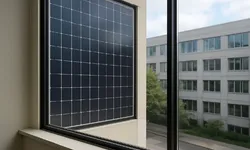
Solar panels have long belonged on rooftops and in open fields. That placement is practical: it keeps equipment out of the way, reduces shading, and makes it easier to aim panels toward the sun. But the next wave of solar hardware is increasingly about surfaces that already exist-especially the vast, underused real estate of building windows.
A growing body of research is exploring photovoltaic materials that can be integrated into glass, allowing windows to generate electricity without turning a room into a cave. The idea is simple to describe and difficult to execute: harvest energy from sunlight while preserving transparency, color quality, durability, and cost targets that the construction industry can accept.
If these "solar windows" mature, they won't replace rooftop solar. They could complement it, shifting part of a building's energy production from a single plane on top to a distributed network across the façade.
Why windows are the next big solar surface
Modern cities are dominated by vertical glass. Office towers, apartment blocks, hospitals, schools, and shopping centers often have more window area than roof area. Even low-rise buildings can have façades that dwarf the usable rooftop space once you account for HVAC equipment, setbacks, and shading from neighboring structures.
That mismatch matters because rooftop solar has a ceiling: you can only install so much on a roof, and the roof's orientation may not be ideal. Windows, by contrast, face multiple directions. East- and west-facing glass can capture morning and afternoon sun that rooftop arrays may miss, and south-facing façades can be productive for long stretches of the day.
There's also a building-design incentive. Glass already plays a role in managing heat and light through coatings and tints. If a window can convert a portion of incoming light into electricity, it can potentially reduce cooling loads while producing power-two benefits from the same surface.
The core challenge: power vs. transparency
Traditional solar panels are opaque because they're designed to absorb as much light as possible. A window, however, is expected to transmit visible light so people can see through it and so interiors remain naturally lit.
That creates a fundamental trade-off. The more light a photovoltaic layer absorbs, the more electricity it can generate, but the darker or more tinted the window becomes. Engineers have been working around this constraint with several strategies:
- Selective absorption: capture energy from parts of the spectrum that humans don't see well (such as some ultraviolet or near-infrared) while letting most visible light pass through.
- Transparent conductors: use conductive layers that don't block light, replacing the metal grids common in conventional panels.
- Edge collection: guide absorbed energy toward the edges of the glass, where small photovoltaic cells can convert it, leaving the central viewing area clearer.
- Micro-patterning: distribute active material in tiny patterns that are less noticeable to the eye, balancing aesthetics and performance.
Each approach comes with engineering compromises. Some improve transparency but reduce output. Others raise output but introduce color shifts, haze, or manufacturing complexity.
How solar windows differ from rooftop panels
Rooftop solar is a mature product category with standardized modules, mounting hardware, and well-understood performance. Solar windows sit at the intersection of photovoltaics and architectural glass, which changes the requirements.
A window is not just an energy device. It must meet building codes, withstand wind loads, handle thermal cycling, resist moisture ingress, and maintain optical clarity over years of sun exposure. It also has to be manufacturable at scale in formats used by the construction industry, including double- or triple-pane insulated glass units.
That means solar-window technology has to solve problems that rooftop panels largely avoid. For example, wiring and connectors must be hidden or integrated into frames. The system has to be serviceable without turning façade maintenance into an electrical project. And because windows are distributed across a building, power electronics and safety design become more complex.
A quick technical primer: what makes a window "solar"
At a high level, a photovoltaic device converts photons into electrical current using semiconductor materials. In a conventional silicon panel, light creates charge carriers that are separated by an internal electric field, producing direct current (DC) power.
Solar windows can use different material systems than rooftop panels. Some concepts rely on thin films that can be deposited onto glass. Others use organic or hybrid materials that can be tuned to absorb specific wavelengths. There are also designs that act more like light concentrators, absorbing or redirecting certain wavelengths toward photovoltaic strips at the perimeter.
Regardless of the material, the window must include transparent electrodes to collect current, encapsulation layers to protect sensitive components, and a way to route power out of the glass and into the building's electrical system. That last step is often overlooked in casual discussions, but it's central to whether a technology can move from lab samples to real façades.
Why interference and placement questions matter
As solar spreads into more places-near roads, on noise barriers, on building skins, and potentially close to existing electrical infrastructure-engineers have to think about interactions with the environment. Research has already explored how solar installations can coexist with nearby power cables with minimal interference, which speaks to a broader theme: solar is becoming a "fit anywhere" technology, not just a rooftop accessory.
For solar windows, the relevant questions shift from ground-mounted spacing to building integration. How does the system behave near metal frames, blinds, or window films? What happens when parts of a façade are shaded by balconies or neighboring buildings? How do you manage partial shading without losing large fractions of output?
These are solvable problems, but they push solar-window designs toward smarter power electronics-such as distributed conversion and better fault detection-so that a single shaded pane doesn't drag down an entire string of windows.
What solar windows could mean for building energy
Buildings consume a large share of electricity, and many owners are under pressure to reduce operational emissions and energy costs. Rooftop solar helps, but it's not always enough-especially for tall buildings with limited roof area relative to floor space.
Solar windows could add a new layer of on-site generation. Even modest output per square meter becomes meaningful when multiplied across hundreds or thousands of panes. The electricity could offset common-area loads, support lighting, or contribute to daytime HVAC demand.
There's also a resilience angle. Distributed generation across a façade could pair with battery storage and building management systems, potentially supporting critical loads during outages. That depends on system design and local regulations, but the architectural integration opens new options.
The construction industry is a tougher customer than consumer tech
A promising lab result doesn't automatically translate into a product architects will specify. Construction materials are expected to last for decades, and building owners care about warranties, maintenance, and replacement cycles.
Solar windows will need to prove they can handle long-term exposure to UV light, temperature swings, and moisture without degrading in ways that are visible or unsafe. They also have to meet fire and electrical safety standards, and they must integrate with existing glazing supply chains.
Cost is another hurdle. Even if a solar window produces useful power, it competes against conventional high-performance glass plus rooftop solar, a combination that is already widely available. The value proposition may be strongest where rooftop space is constrained, where façade aesthetics matter, or where building codes and sustainability targets reward on-site generation.
Grid and policy implications: more generation, more complexity
If solar windows become common, utilities and regulators will face a familiar challenge in a new form: many small generators connected across a city. Rooftop solar already does this, but façade-integrated solar could increase the number of generation points per building.
That raises practical questions about interconnection, metering, and safety disconnects. It also affects how buildings manage power quality and how they export or self-consume electricity. In some markets, compensation rules for exported solar energy influence whether owners prioritize self-consumption with storage or feed power back to the grid.
For cities, solar windows could become part of building-performance standards. If policymakers want more on-site generation without dedicating land to solar farms, building-integrated photovoltaics offer an appealing path-provided the technology can meet durability and cost expectations.
What to watch next
The most important milestones for solar windows are less about flashy prototypes and more about manufacturing and deployment details. Can the technology be produced in large panes with consistent optical quality? Can it be laminated into insulated glass units without compromising performance? Can installers and electricians work with it safely and efficiently?
Performance will matter, but so will the "boring" parts: wiring routes, connectors, sealing methods, and how the system is monitored and maintained over time. If those pieces come together, windows could join rooftops as a standard surface for harvesting solar energy.
For now, the direction is clear. Solar is expanding beyond the roofline, and the building envelope is becoming part of the power system.