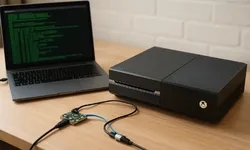
The original Xbox One-the bulky 2013 launch model that earned the "VCR" nickname-has reportedly been jailbroken. Not a softmod delivered through a browser exploit or a game save trick, but a hardware-led bypass aimed at the console's earliest security layer.
According to reports, researchers used a technique called voltage glitching to defeat protections in the Xbox One's boot ROM, enabling the system to run unofficial software. For a platform that has spent more than a decade receiving security updates and living under Microsoft's modern console security model, the timing is part of the story: hardware weaknesses don't expire just because a product is old.
Why the 2013 Xbox One still matters
The first Xbox One arrived in a very specific moment for consoles. It launched into a generation where online services were central, digital purchases were becoming the default, and platform holders were tightening control over what code could run on consumer hardware.
That original machine also carried baggage. It was positioned as an all-in-one living room device, shipped with Kinect, and entered the market with a higher price and weaker game performance than its closest rival. Over time, Microsoft adjusted course-dropping the Kinect bundle, iterating on hardware with the One S and One X, and building out services that now define Xbox as much as any single console.
A jailbreak of the launch model doesn't rewrite that history, but it does reopen a technical conversation: what does it take to break a modern console when software vulnerabilities have been patched for years?
Jailbreak, homebrew, and piracy: the same tool, different outcomes
"Jailbreak" is a loaded term in console circles because it can describe several very different goals. At the technical level, it usually means gaining the ability to execute code that the manufacturer didn't sign or approve-often called unsigned code execution.
From there, outcomes diverge:
- Homebrew: community-built apps, utilities, emulators, and experiments that weren't possible under the stock security model.
- Preservation and research: studying the platform, documenting security design, and keeping older hardware useful after official support fades.
- Cheating and piracy: the most controversial uses, and the reason console makers treat unsigned code as an existential threat.
Reports around the Xbox One jailbreak focus on the security bypass itself-getting past the boot ROM-rather than on a polished end-user tool. That distinction matters. A lab-grade exploit that requires hardware access and specialized equipment can be a breakthrough for researchers without immediately becoming a mass-market mod.
What is a boot ROM, and why is it such a big deal?
The boot ROM is the first code a device runs when it powers on. It's typically stored in read-only memory on the chip and is designed to be immutable after manufacturing. That immutability is the point: if the boot ROM is trustworthy, it can verify the next stage of the boot process, which verifies the next, creating a chain of trust.
On a console, that chain of trust underpins everything: the operating system, the hypervisor or security monitor, and the rules that prevent unsigned games and apps from running. If an attacker can compromise the boot ROM stage, they can potentially undermine the entire chain-because every later check depends on the earliest check being reliable.
Software updates can patch vulnerabilities in later boot stages or the OS. They can't rewrite a true ROM. That's why boot ROM bypasses are rare, prized, and often tied to physical attacks rather than remote ones.
Voltage glitching, explained in plain terms
Voltage glitching is a hardware fault-injection technique. Instead of "hacking" the code in the traditional sense, the attacker briefly disrupts the chip's power (or sometimes its clock) at a precisely timed moment. The goal is to cause the processor to misbehave in a controlled way-skipping an instruction, misreading a value, or failing a security check.
Think of it as forcing a split-second stumble during a critical step, such as verifying a digital signature. If the verification routine is interrupted at exactly the wrong time, the system may proceed as if the check passed even when it didn't.
In practice, "precisely timed" is doing a lot of work. Glitching typically requires:
- Physical access to the device and its board-level signals.
- Specialized equipment to generate repeatable, tunable glitches.
- Iteration-many attempts to find the timing window that produces the desired fault without crashing the system.
That's why these attacks often start in research settings and only later-sometimes much later-turn into something approachable for hobbyists.
Why this approach shows up late in a console's life
A reported jailbreak nearly 13 years after launch sounds surprising until you look at the incentives and the difficulty curve. Early in a console generation, attackers often chase software bugs because they can be exploited remotely and distributed widely. Platform holders respond quickly with patches, bans, and architectural changes.
Hardware attacks are different. They can be more durable because they target the physical implementation, but they're also more expensive and time-consuming to develop. As hardware ages, a few things change in favor of researchers:
- Used consoles become cheaper and easier to sacrifice during experimentation.
- Documentation, teardowns, and community knowledge accumulate.
- The commercial value of a mass-market piracy tool may decline, leaving more room for academic or hobbyist motivations.
A boot ROM-level bypass also tends to be the kind of work that benefits from patience. Even when the underlying concept is known, turning it into a reliable method can take a long time.
What it could enable on an Xbox One
If the reported jailbreak truly provides a path to run unsigned code, it could open doors that have been closed on retail Xbox One hardware. That doesn't automatically mean a full alternative operating system or a simple "install anything" experience. Modern consoles are layered, and breaking one layer doesn't always grant clean control of the next.
Still, the kinds of capabilities people typically explore after a successful early-boot compromise include:
- Custom bootloaders that can launch research payloads or diagnostics.
- Deeper system introspection for reverse engineering and documentation.
- Homebrew environments that bypass the normal app signing pipeline.
- Preservation tooling for studying how games and services interact with the platform.
There's also a practical ceiling: the Xbox One ecosystem is heavily tied to online services. Even if a console can run unofficial code, connecting to official networks may carry risk, and many modern games rely on server-side components that can't be "unlocked" by local control alone.
Microsoft's security model, and why physical attacks are hard to eliminate
Console security is designed around the assumption that the attacker owns the hardware. That's a harsher threat model than most consumer electronics, and it's why consoles use secure boot chains, hardware-backed key storage, and aggressive integrity checks.
But physical access changes the game. With probes, rework tools, and fault-injection gear, attackers can target the boundary between "trusted" and "untrusted" in ways software can't easily defend against. Mitigations exist-glitch detectors, redundant checks, random delays, hardened power delivery, and secure elements-but they add cost and complexity, and they're not always perfect.
A reported boot ROM bypass via glitching is a reminder that the security of a device is not only about cryptography. It's also about electrical engineering, timing, and how silicon behaves under stress.
Industry implications: preservation, repair culture, and the long tail of hardware
For the games industry, jailbreaks sit at an uncomfortable intersection of legitimate and illegitimate uses. Publishers and platform holders worry-reasonably-about piracy and cheating. At the same time, older consoles eventually fall out of official support, online services change, and digital storefronts can disappear.
That's where the preservation argument gains weight. When a platform's official tooling is gone, the ability to run community software can keep hardware relevant for research, accessibility projects, and archival work. It can also support repair culture by enabling diagnostics and replacement workflows that manufacturers never shipped to consumers.
None of that requires endorsing misuse. It does suggest that the conversation around console security is broader than "lock it down" versus "break it open." The longer a device exists, the more its value shifts from commercial control to historical and technical relevance.
What to watch next
The key questions now are practical ones. How repeatable is the reported method? Does it require invasive soldering or chip-level access? Can it be performed on stock retail units at scale, or is it mainly a proof of concept? And does it lead to stable unsigned code execution, or only to limited early-boot behavior?
For the original Xbox One, a reported boot ROM bypass is less about reviving a console war-era box and more about what it reveals: even in tightly controlled platforms, the physical world still has leverage. Security doesn't end at the firmware update screen.