Data storage has become a game of speed and scale. Cloud providers race to pack more capacity into data centres, while users expect instant access to everything from family photos to enterprise databases. But beneath that fast-moving layer sits a slower, stubborn problem: how to keep information safe for decades, centuries, or longer.
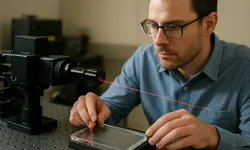
Microsoft researchers have been working on a different answer to that question-one that swaps spinning disks and magnetic tape for glass. Using lasers to write data into glass, the team has demonstrated a path toward storage media that could, in principle, preserve information for thousands of years. The vision goes further than a lab demo: think automated, robotic libraries filled with glass tablets, each packed with data and designed to survive conditions that would destroy conventional media.
The idea sounds like science fiction, but it is rooted in a practical need. Data centres are already built around tiers: fast storage for active workloads, and cheaper, slower storage for archives. Glass targets the deepest archive tier-data that must be kept, rarely accessed, and protected against time itself.
Why long-term storage is harder than it looks
Most digital storage is engineered for performance and cost, not longevity. Hard drives have moving parts and limited service lives. Solid-state drives avoid mechanics but still face wear and data retention limits. Optical discs can last longer, but consumer-grade media varies widely in durability and can be sensitive to heat, light, and manufacturing quality.
Magnetic tape remains the workhorse for cold storage in many large environments because it is relatively inexpensive and energy-efficient when stored offline. Yet tape is not "set and forget." It requires controlled environments, periodic migration to new formats, and an operational discipline that assumes future readers and compatible hardware will exist.
That migration treadmill is a hidden cost of the digital age. If you want data to survive for centuries, you cannot just store it; you must keep rewriting it as technologies change. A medium that can hold data for extremely long periods without refresh cycles could reduce that burden, at least for certain classes of information.
How writing data into glass works
Microsoft's approach uses lasers to encode information inside glass. Instead of storing bits as magnetic orientations or electrical charges, the system creates tiny physical modifications within the material. These modifications can be arranged in patterns that represent data.
A useful way to think about it is "3D optical storage," but with a twist. Traditional optical media stores data on a surface layer. Writing into glass opens up volume: data can be encoded at different depths, potentially increasing density and enabling a robust physical record that is less exposed to surface damage.
Reading the data involves imaging and interpretation. The written structures affect how light passes through the glass, and a reader can capture those changes. Software then reconstructs the stored bits from the observed patterns.
This is not a consumer technology. It is aimed at industrial-scale archiving where write-once, read-rarely behaviour is acceptable. The value proposition is durability and stability, not quick rewrites.
From a lab sample to a "robotic library"
The description of "robotic libraries full of glass tablets" points to a familiar data-centre pattern. Hyperscale operators already use automated systems to move storage media around. Tape libraries, for example, rely on robots that fetch cartridges and load them into drives when data is requested.
A glass-based archive could follow a similar model. Glass "cartridges" or tablets would sit in racks or slots. When a retrieval request comes in, a robot could select the appropriate piece of media, bring it to a reader, and stream the data back into the system.
Automation matters because deep archives are not meant to be handled by people. Manual processes are slow, error-prone, and expensive at scale. A robotic workflow also makes it easier to keep the archive offline most of the time, which can improve security against certain threats.
The concept also hints at a separation between the durable medium and the active hardware. Readers and writers can evolve over time, while the glass remains stable. That separation is central to any long-lived archive strategy.
What glass changes for durability
Glass is attractive because it is chemically stable and can tolerate conditions that degrade other media. It does not rely on magnetism, which can be disrupted, and it does not store charge the way flash memory does. A properly engineered glass medium could be resilient to temperature swings, moisture, and other environmental stressors.
Durability is not just about the medium surviving. It is also about the data remaining readable. A long-lived archive must anticipate that future systems may not have today's hardware or file formats. That is why archival planning often includes redundancy, documentation, and sometimes even storing decoding instructions alongside the data.
Glass does not solve the format problem by itself, but it can make the physical layer far less fragile. If the medium lasts for millennia, archivists can focus on ensuring that future readers can interpret what is stored.
Density, throughput, and the economics of cold storage
Any new storage medium has to compete on more than longevity. Data centres care about cost per terabyte, energy use, physical footprint, and operational complexity. Glass storage will be judged on how much data it can hold, how quickly it can be written and read, and how expensive the end-to-end system becomes once robotics and readers are included.
Laser writing suggests a trade-off. Writing data with precision optics can be slower than magnetic recording, and the equipment may be specialized. That is not necessarily a deal-breaker for deep archives, where data is written once and accessed infrequently. But it does shape which workloads fit.
Retrieval speed is another factor. A robotic library introduces latency: the system has to fetch the medium, load it, and read it. Again, that is acceptable for archival retrieval, legal compliance, or historical datasets, but it will not replace the storage used for active applications.
If glass can reduce the need for periodic migration, it could shift the economics. Migration consumes labour, hardware, and time, and it introduces risk. A medium designed to outlast multiple generations of storage technology could lower long-term operational overhead, even if the initial system is more expensive.
Where glass archives could matter first
The most obvious use cases are those where data must be preserved for very long periods and is rarely accessed. That includes cultural heritage archives, scientific datasets that need to remain available for future research, and institutional records with long retention requirements.
Large technology companies also have their own reasons to care. Cloud providers store enormous volumes of customer data, and they offer archival tiers designed for infrequent access. A glass-based tier could become another option in that stack, particularly for customers who prioritize durability over retrieval speed.
There is also a security angle. Offline or nearline archives can be less exposed to ransomware and other attacks that target online storage. A robotic library that keeps media physically separated from the network most of the time can be part of a broader resilience strategy.
None of this means glass replaces existing systems. It suggests a new layer for the coldest of cold storage-data that organizations cannot afford to lose, even across centuries.
Technical hurdles that still matter
A durable medium is only one piece of a storage system. The writer and reader hardware must be reliable, maintainable, and manufacturable at scale. Laser systems need calibration. Optical readers need consistent interpretation. Robotics must operate for years with minimal downtime.
Error correction and verification are also central. Archival systems typically use redundancy and integrity checks to detect and correct errors. With a new medium, engineers must prove that data can be read back accurately after long periods and under different environmental conditions.
Then there is standardization. Long-lived archives benefit from open specifications and widely available tooling. If a storage format depends on proprietary readers, it can create a different kind of fragility: the medium may last, but the ecosystem might not.
Microsoft's research signals that these questions are being explored, but turning a research prototype into a dependable archival platform is a long engineering road.
What it could mean for the data centre of the future
Data centres already resemble industrial facilities, with specialized power, cooling, and automation. A glass archive adds another industrial element: a physical library of durable media managed by robots and accessed through optical systems.
That model fits a broader trend toward separating compute from storage and separating hot storage from deep archives. It also aligns with the idea that not all data needs to live on always-on, energy-consuming systems. If a portion of the world's stored information can be kept in a stable, offline form, it changes how operators think about energy use and infrastructure planning.
The bigger implication is philosophical as much as technical. Digital information has always been strangely fragile: easy to copy, easy to lose, and hard to preserve without constant effort. A medium designed to last thousands of years pushes back against that fragility.
For now, glass storage remains a research-driven approach with a clear target: the deepest archives. If it matures into a deployable system, the "robotic library" may become a standard feature of future data centres-quietly holding the records that need to outlive the machines that created them.