Wireless networks are running into a familiar problem: demand keeps climbing, but the airwaves are finite. Homes and offices now juggle video meetings, 4K streaming, cloud gaming, smart appliances, and an expanding set of sensors. Even when a router is new and the broadband line is fast, the last few meters over Wi‑Fi can become the bottleneck.
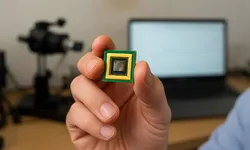
A research team is pointing to a different way to move data through the air-by using light instead of radio. The group demonstrated a laser-based wireless approach that reached 360 Gbps and, in their analysis, used roughly half the energy of Wi‑Fi for the same data transfer. The core of the system is a compact chip that integrates dozens of tiny lasers, turning what is often a lab-bench optical setup into something closer to a component that could be engineered into devices.
The result sits in the broader family of "optical wireless" or "free-space optical" communications. The idea has been around for years, but the new work highlights how photonic integration-packing optical components onto a chip-can push the technology toward practical, high-capacity links.
Why Wi‑Fi is straining
Wi‑Fi has improved dramatically, but it still shares a basic constraint with every radio system: spectrum is scarce and interference is common. Multiple devices compete for the same channels, and signals bounce off walls, floors, and furniture. In dense environments such as apartment buildings, offices, and public venues, neighboring networks overlap and performance can degrade quickly.
Modern Wi‑Fi standards mitigate these issues with wider channels, better modulation, multi-user scheduling, and multiple antennas. Those techniques help, but they also increase complexity and power consumption. As data rates rise, the energy cost of moving each bit becomes a bigger part of the total footprint of networking-especially for battery-powered devices and for infrastructure that runs 24/7.
That's where optical wireless becomes attractive. Light offers enormous bandwidth potential, and it does not crowd the radio spectrum. It can also be more spatially contained: a beam can be directed, reducing the chance of interfering with other links nearby.
From radio waves to light: what changes
Traditional Wi‑Fi transmits information by modulating radio-frequency signals. Optical wireless transmits information by modulating light intensity, phase, or frequency and sending it through free space. The receiver converts the incoming light back into an electrical signal.
In practice, optical wireless can take different forms. Some systems use LEDs for short-range "visible light communication," sometimes discussed alongside Li‑Fi concepts. Others use infrared lasers, which can carry far more data and can be engineered into narrow beams for point-to-point links.
The reported 360 Gbps demonstration falls into the laser-based camp. Lasers can be tuned and stabilized, and multiple wavelengths can be used in parallel. That parallelism is a key reason optical fiber networks carry so much data, and it can be applied to free-space links as well.
The chip at the center of the breakthrough
A major barrier for optical wireless has been the hardware. High-performance optical transmitters often rely on discrete components-separate lasers, modulators, and control electronics-assembled with careful alignment. That can be expensive, bulky, and sensitive to vibration or temperature changes.
The new approach uses a tiny chip that integrates dozens of miniature lasers. Photonic integration aims to do for optics what integrated circuits did for electronics: shrink components, reduce assembly steps, and improve repeatability. Instead of aligning many separate lasers, a single chip can generate multiple optical carriers that can be modulated and combined.
Having many lasers on one chip also supports a straightforward scaling strategy. More wavelengths can mean more aggregate throughput, assuming the rest of the system-modulators, drivers, and receivers-can keep up. It also opens the door to redundancy and dynamic allocation, where a system could adapt which wavelengths it uses based on conditions.
The researchers' energy claim-about half the energy of Wi‑Fi for equivalent data transfer-fits with a broader trend in photonics: when engineered well, optical links can move large amounts of data with favorable energy-per-bit characteristics. The details depend on the full system design, including how the optical signals are generated, modulated, detected, and processed.
How 360 Gbps is possible in the air
A 360 Gbps wireless link is far beyond typical consumer Wi‑Fi throughput. Achieving that kind of rate usually requires combining multiple techniques:
- Parallel channels through multiple wavelengths (each laser acting as a separate carrier).
- High-order modulation to encode more bits per symbol, assuming the signal-to-noise ratio is sufficient.
- High-speed photonic and electronic components that can modulate and detect signals at very high bandwidths.
- Directional transmission to keep the optical power concentrated and reduce interference.
Optical wireless also benefits from the fact that the carrier frequency of light is extremely high compared with radio. That doesn't automatically translate into usable bandwidth, but it enables wide optical spectra and dense wavelength-division multiplexing concepts that are familiar from fiber networks.
At the same time, free-space optical links face their own physics. Alignment matters. A narrow beam can deliver high capacity, but it must be aimed accurately at the receiver. For short indoor distances, that may be manageable with careful optics and tracking. For mobile devices, it becomes a harder engineering problem.
Energy efficiency: why light can help
Energy use in wireless systems comes from several places: generating the carrier, amplifying and filtering signals, running baseband processing, and keeping radios awake to coordinate access to the medium. Wi‑Fi also spends energy dealing with contention and retransmissions, especially in crowded environments.
Optical wireless can reduce some of those costs. A directed optical link can behave more like a private pipe than a shared channel, potentially lowering overhead. If the link is stable and interference is low, fewer retransmissions are needed. And because the system can use multiple optical carriers in parallel, it can deliver high throughput without pushing a single channel to extremes.
The "half the energy of Wi‑Fi" comparison should be read as a research result tied to a specific setup and assumptions. Real-world energy performance will depend on implementation details, including how the optical front end is packaged, how much power is needed for beam steering or tracking, and how efficiently the receiver converts light into electrical signals.
Where laser wireless could show up first
Even if laser-based wireless is not ready to replace Wi‑Fi in every room, there are several places where it could be useful sooner:
- Short-range ultra-high-speed links between devices in the same room, such as VR headsets, docking stations, or media hubs.
- Backhaul inside buildings where running new fiber is difficult, but line-of-sight links are possible between fixed points.
- Data center and lab environments that need flexible, reconfigurable high-bandwidth connections over short distances.
- Industrial settings where radio interference or spectrum restrictions make RF links challenging, assuming safety and reliability requirements are met.
These scenarios share a theme: controlled spaces, predictable geometry, and a strong incentive for high throughput. They also reduce the hardest consumer challenge-supporting many moving devices with constantly changing orientations.
The engineering hurdles still in the way
Optical wireless is not a drop-in replacement for Wi‑Fi. Several practical issues need to be solved before it can become mainstream:
- Line-of-sight and blockage: light does not pass through walls, and even people walking through a beam can interrupt a link.
- Beam steering and tracking: maintaining alignment with moving devices requires fast, reliable steering mechanisms or wider beams that trade capacity for robustness.
- Safety and regulatory considerations: laser systems must meet eye-safety requirements, and products must be designed to avoid hazardous exposure.
- Packaging and cost: integrated photonics can shrink the optics, but the full module-lasers, drivers, optics, thermal management, and calibration-must be manufacturable at scale.
- Network integration: real deployments need handoff between optical links and RF, plus scheduling and security models that fit existing networks.
There is also a user-experience question. Wi‑Fi works because it is forgiving; signals reflect and reach devices even when they are in a pocket or behind a laptop screen. Optical systems may need hybrid designs that fall back to RF when the optical path is blocked.
What it could mean for the wireless industry
If photonic chips with many integrated lasers can be produced reliably, they could reshape how engineers think about short-range connectivity. Instead of squeezing more efficiency out of crowded radio bands, device makers could offload the heaviest traffic-uncompressed video, high-speed file transfers, low-latency VR streams-onto optical links when conditions allow.
That would not eliminate Wi‑Fi. It would change its role. Wi‑Fi could remain the universal coverage layer, while optical wireless becomes a high-capacity overlay for specific tasks and spaces. Similar layering already exists in networks, where different technologies handle coverage, capacity, and mobility in complementary ways.
The research also underscores a broader convergence: photonics is moving closer to the edge. Optical components are no longer confined to long-haul fiber networks and data center racks. As integration improves, optical transmitters and receivers can be considered for consumer and enterprise devices, provided the economics and usability line up.
A glimpse of a post-radio hotspot
A 360 Gbps laser wireless link is a reminder that "wireless" does not have to mean "radio." Light-based links can deliver fiber-like speeds without a cable, at least over short distances and under the right conditions. The integrated multi-laser chip approach suggests a path toward compact, scalable hardware rather than one-off lab assemblies.
The next steps are likely to be less about headline speeds and more about engineering: making the links robust to motion and blockage, integrating them with existing network stacks, and proving that the energy savings hold up in real devices. If those pieces come together, the future of local connectivity may look less like a crowded spectrum chart and more like a set of invisible beams quietly moving data around a room.