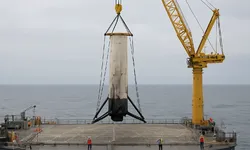
China has successfully recovered an orbital rocket booster for the first time, bringing a key capability-controlled first-stage recovery-into operational reality for the country's launch program. The milestone came during the maiden flight of the Long March 10B, whose first stage was brought down onto a sea-based platform equipped with a net system.
The achievement matters less as a single dramatic landing and more as a signal that China is now testing the full end-to-end choreography required for reusability: guidance back from hypersonic speeds, atmospheric reentry control, terminal descent, and a managed touchdown on a prepared target at sea.
What flew: Long March 10B and its first-stage recovery
According to the state-owned China Aerospace Science and Technology Corporation (CASC), the Long March 10B is a two-stage rocket standing about 207 feet (63 meters) tall. CASC is the main contractor for China's space program and a central player in the country's launch vehicle development.
On its first orbital launch, the vehicle's first stage was recovered in a controlled manner, landing into a net-equipped sea platform. Sea-based recovery is a practical choice for early operations: it reduces overflight concerns, expands the range of possible landing corridors, and allows teams to position the landing target where it best fits the mission's trajectory and safety constraints.
The "net" detail is also telling. It suggests a capture or stabilization approach designed to reduce tip-over risk and simplify securing the stage immediately after touchdown-an especially relevant concern on a moving ocean platform where wind, waves, and residual vehicle motion complicate post-landing handling.
Why booster recovery is hard-and what "controlled" implies
Recovering an orbital-class first stage is not the same as retrieving a suborbital test article. The booster separates at high speed after pushing the upper stage toward orbit, then must manage a sequence of events that are unforgiving of small errors.
A controlled recovery generally implies the booster retained attitude control after separation, executed a guided reentry profile, and performed a terminal landing maneuver rather than splashing down uncontrolled. That requires a combination of onboard navigation, propulsion capability for descent and landing, and aerodynamic control authority during the thickening atmosphere.
The basic technical ingredients typically include:
- Guidance, navigation, and control (GNC): The booster must know where it is and where it needs to be, then steer itself through changing aerodynamic forces and engine thrust.
- Thermal and structural resilience: Reentry heating and dynamic pressure can stress tanks, engine sections, and interstage structures.
- Propulsive landing capability: A restartable engine (or engines) and sufficient propellant margin are needed to slow down and land softly.
- Landing stabilization: Legs, capture hardware, or a net/catch system must manage the final seconds when the vehicle is most vulnerable to tipping or drifting.
Even with mature software and hardware, the landing phase compresses many risks into a short window. Wind shear, sensor noise, engine performance variation, and platform motion can all turn a "near miss" into a loss. That is why a first successful controlled recovery is a meaningful engineering marker, even before any discussion of refurbishment and reflights.
Sea platforms: flexibility, safety, and operational tradeoffs
Landing at sea offers flexibility in mission planning. A booster can return downrange to a platform positioned along the flight path, rather than performing a more propellant-expensive boost-back to a land site. For some missions, downrange recovery can preserve payload performance because the rocket spends less propellant on returning the stage.
There are tradeoffs. Ocean operations add complexity: saltwater corrosion risk, rough seas, and the logistics of towing, securing, and transporting a large stage. A net-equipped platform may help mitigate some of those issues by reducing the time between touchdown and stabilization, which is crucial if the stage needs to be protected from damage or contamination.
Sea recovery also changes the ground segment. It demands maritime coordination, tracking assets, and procedures for safe approach and handling of a vehicle that may still contain residual propellants and pressurized systems.
Reusability isn't just a landing-it's a production and refurbishment system
A recovered booster is only the first step toward meaningful reusability. The larger goal is to turn recovery into a repeatable process that reduces cost and increases launch cadence. That requires a manufacturing and operations pipeline that treats the booster as an asset to be cycled, not a one-off stage to be displayed or studied.
Key questions now shift from "can it land?" to "can it fly again?" and "how quickly?" Those questions depend on factors that are rarely visible from a single mission announcement:
- Inspection burden: How much disassembly is required to certify the stage for another flight?
- Engine reuse: Are the engines designed for multiple starts and multiple missions with limited refurbishment?
- Turnaround time: Can the stage be processed in weeks rather than months?
- Reliability management: How will the program track wear, fatigue, and component life across flights?
A net-assisted landing approach may also influence refurbishment. If the system reduces landing loads or prevents tip-over, it could lower the amount of structural repair needed after recovery. On the other hand, any capture system introduces its own interface points and potential for localized damage if not carefully controlled.
What this means for China's launch ecosystem
China's space program spans government missions, commercial launches, and a growing set of domestic aerospace firms. A successful controlled recovery by a state-led prime contractor can have ripple effects across that ecosystem, setting technical benchmarks and shaping expectations for future vehicles.
At the program level, reusability can support higher launch rates by reducing the need to build a brand-new first stage for every mission-assuming refurbishment is efficient. It can also provide strategic flexibility: if a booster can be recovered and returned to service, it becomes easier to respond to schedule changes, replace delayed vehicles, or maintain cadence during periods of high demand.
There is also a signaling effect. Demonstrating controlled recovery places China in a smaller club of launch providers that have publicly shown the ability to bring back an orbital-class booster in a targeted, managed landing. That can influence how customers, partners, and competitors assess the trajectory of China's launch capabilities, even without any immediate claims about cost or flight rate.
The engineering path ahead: repeatability, precision, and scale
A first recovery is a beginning, not an endpoint. The next phase typically involves proving repeatability across different mission profiles, weather conditions, and landing scenarios. Precision matters too: consistent landings reduce risk to the platform and simplify recovery operations.
Scaling recovery operations can also require multiple platforms, improved maritime logistics, and streamlined post-flight processing. Each of those elements becomes part of the system that determines whether reusability is an occasional demonstration or a routine operational capability.
For the Long March 10B specifically, the maiden launch and recovery will likely feed back into design refinements-software tuning, structural reinforcement where needed, and operational procedures for securing and transporting the stage. The most important data may come from what happens after the landing: the condition of the engines, tanks, avionics, and thermal protection areas, and how much work is required to prepare the stage for any future use.
A milestone with broader implications
China's first successful controlled recovery of an orbital rocket booster adds a new capability to its launch toolbox. It also underscores a broader industry reality: launch is no longer only about reaching orbit. Increasingly, it is about what happens after stage separation-how much hardware can be brought back, how reliably, and how quickly it can be turned around.
The Long March 10B recovery shows that China is now executing that playbook in the real world, not just in test campaigns. The next chapters will be written in the cadence of follow-on flights, the consistency of landings, and whether recovered stages become routine assets rather than singular achievements.