Robots don't need emotions to be useful, but they do need self-preservation. In factories, hospitals, and homes, machines increasingly share space with people and delicate objects, and the ability to detect harmful contact quickly can matter as much as vision or balance.
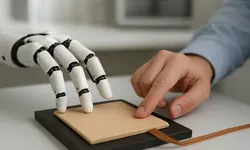
A research team in China is pushing that idea forward with what it calls an NRE-skin-an artificial skin designed to make robots sensitive to damaging touch in a way that resembles biological nerves. The work argues that today's electronic skins often waste energy and generate overwhelming streams of raw data. The proposed alternative is event-driven: pressure sensors that emit electrical pulses whose frequency changes with force, closer to how neurons encode intensity.
Why "pain" is a useful metaphor in robotics
Calling it "pain" can sound like science fiction, but in robotics the term usually points to something practical: a system that recognizes potentially harmful contact and triggers a protective response. Humans don't measure pressure by continuously sampling every square millimeter of skin and sending it to the brain as a high-resolution image. Instead, nerve endings convert mechanical stimuli into spikes-brief electrical events-and the nervous system reacts quickly when those spikes suggest danger.
Robots, by contrast, often rely on sensors that behave more like cameras than nerves. Many tactile arrays continuously read out analog values from a grid of sensing elements. That can provide rich information for tasks like grasping and texture recognition, but it also creates a constant data pipeline that must be powered, digitized, transmitted, and interpreted. For a robot with large-area coverage-hands, arms, torso-that pipeline can become expensive in energy and compute.
The "pain" framing is also about priorities. A robot doesn't always need full tactile detail. It needs to know when something is wrong, and it needs to know fast. Event-driven sensing is one way to shift from "always-on measurement" to "only speak when something happens."
The problem with conventional electronic skin
Electronic skin, or e-skin, is a broad category. It can be built from capacitive, piezoresistive, piezoelectric, triboelectric, optical, or magnetic sensing elements, among others. Many designs aim for high spatial resolution and continuous readout, which is valuable for dexterous manipulation and for detecting subtle contact patterns.
But the paper behind the NRE-skin highlights two recurring bottlenecks: power consumption and data volume. Continuous sampling means the system is always spending energy to measure, even when nothing is touching the robot. It also means the robot's processors must handle a steady stream of sensor values, most of which may be redundant during idle periods.
That burden shows up in several places:
- Power draw at the edge: large sensor arrays require biasing, scanning, and signal conditioning.
- Bandwidth and wiring: high-channel-count skins can demand complex interconnects and multiplexing.
- Compute overhead: interpreting tactile "images" can require filtering, compression, and machine learning inference.
- Latency: the time from contact to action can stretch if the system must first assemble and process a full frame of data.
These constraints don't make e-skin impractical. They do shape where it can be deployed. A research prototype on a lab hand is one thing; a rugged, full-body skin on a mobile robot that must run all day is another.
What the NRE-skin changes: from values to pulses
The core idea described in the paper is straightforward: each pressure sensor in the skin directly generates electrical pulses, and the frequency of those pulses encodes the magnitude of the pressure. That is a notable departure from typical tactile arrays that output continuous voltage or resistance changes that then need to be sampled and digitized.
In biological terms, it's closer to a spiking neuron model. A stronger stimulus produces a higher firing rate. A weaker stimulus produces fewer spikes. The information is carried by timing and frequency rather than by a continuously varying analog level.
This approach can reduce data in a very direct way. If nothing touches the robot, there are few or no pulses. When contact occurs, the skin "speaks up" with events that can be routed to a controller. Instead of streaming a full tactile frame at a fixed rate, the system transmits sparse events that are naturally compressed by the physics of the sensor.
It also changes how the robot can respond. A controller can be designed to react to spikes immediately, without waiting for a full scan cycle. That can matter for safety behaviors like pulling away, reducing grip force, or stopping a joint when contact becomes excessive.
Event-driven sensing and neuromorphic compatibility
Event-driven outputs align with a broader trend in sensing: moving from frame-based data to asynchronous events. The best-known example is event-based vision, where cameras output changes in brightness rather than full images at a fixed frame rate. The appeal is similar-lower latency, lower redundancy, and potentially lower power.
A pulse-based tactile skin can also pair naturally with neuromorphic computing approaches that process spikes rather than dense numerical arrays. Even without specialized neuromorphic chips, spiking signals can be handled efficiently by microcontrollers and interrupt-driven logic. The key is that the sensing modality itself is doing part of the encoding work.
That doesn't automatically make the system "smarter." It changes the interface. Engineers still need algorithms to interpret patterns of spikes across many sensors, distinguish accidental bumps from sustained pressure, and decide what constitutes "harm." But it can make those algorithms more efficient, because they can focus on events rather than on constant background readings.
What "pain" detection could look like in practice
A robot that can detect harmful touch needs more than a sensor. It needs thresholds, context, and a response policy. A pulse-frequency output provides a natural signal for that: higher frequency can map to higher urgency.
In practical deployments, a "pain-like" tactile layer could support behaviors such as:
- Protective reflexes: rapidly reducing actuator torque or stopping motion when pressure spikes exceed a limit.
- Grip safety: preventing crushing forces in robotic hands by detecting rising pressure early.
- Collision awareness: identifying unexpected contact on arms or body panels and triggering avoidance.
- Wear monitoring: flagging repeated high-pressure events that may damage coverings or joints.
The paper's emphasis on power and data suggests a target beyond single-purpose grippers. It points toward larger-area skins where continuous readout would be costly, and where sparse, event-driven reporting could make coverage more realistic.
Engineering trade-offs: what you gain, what you give up
Event-driven tactile sensing is not a free upgrade. It shifts the design space. Continuous tactile arrays can capture fine gradients and static pressure distributions with high fidelity, which is useful for tasks like slip detection, object shape estimation, and delicate manipulation. A pulse-based system can represent intensity through frequency, but the details of spatial patterns and slow-changing forces depend on how the pulses are generated and interpreted.
There are also integration questions. A robot skin must be flexible, durable, and tolerant of repeated deformation. It must survive abrasion, temperature changes, and exposure to oils or cleaning agents in real environments. Wiring and packaging matter as much as the sensing principle.
Then there's calibration. If each sensor produces pulses, manufacturing variation could lead to different frequency responses under the same pressure. That can be managed through per-sensor calibration or adaptive algorithms, but it adds complexity.
Finally, "pain" is not just high pressure. Humans experience pain from heat, cold, chemical irritation, and sharpness. A pressure-only system can still be valuable, but it's one slice of a broader tactile safety stack that may also include force-torque sensors at joints, motor current monitoring, proximity sensing, and vision.
Industry implications: safer robots, leaner sensing stacks
If the NRE-skin approach scales, it could influence how robotics companies think about tactile coverage. Today, many commercial robots rely on limited contact sensing-force sensors at the wrist, bump sensors, or torque estimation-because full-body tactile skins are hard to deploy at scale. A lower-data, lower-power tactile layer could make broader coverage more feasible, especially for mobile manipulators operating around people.
It could also change the economics of tactile perception. When sensors produce less data, the downstream compute requirements can shrink. That can reduce the need for high-end processors dedicated to tactile processing, or free up compute for other tasks like navigation and planning.
For research, pulse-based tactile skins may encourage new algorithms that treat touch as a stream of events rather than as an image. That aligns with a growing interest in real-time, reactive control-systems that respond quickly to the world instead of building heavy internal models first.
The bigger picture is that robotics is gradually adopting ideas from biology where they make engineering sense. Not because robots need to "feel" in a human way, but because biological systems have already solved problems like low-power sensing and fast reflexes under tight constraints.
What to watch next
The paper's claim-that traditional e-skins consume a lot of power and generate too much raw data, and that NRE-skin addresses this by having each sensor generate frequency-coded pulses-sets a clear direction. The next questions are about robustness and deployment: how large the skin can scale, how it performs under real-world wear, and how easily it integrates with existing robot control systems.
Equally important is how designers define "pain" operationally. A useful system needs tunable thresholds, context awareness, and predictable behavior. A robot that stops constantly from harmless brushes is not safe in practice; it's unusable. A robot that ignores damaging contact is worse.
A skin that speaks in pulses rather than numbers won't solve those policy questions on its own. But it offers a different foundation-one that aims to keep robots attentive to harmful touch without forcing them to listen to their own skin all the time.