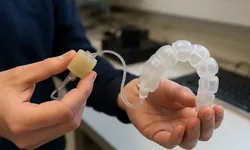
Soft robots promise machines that can squeeze through tight gaps, grip delicate objects, and move with a kind of biological grace that rigid mechanisms struggle to match. Their bodies can be made from elastomers, gels, and textiles that bend, twist, and stretch without breaking.
But there has been a stubborn mismatch at the center of many soft systems. The actuators that make soft robots move often depend on fluid pressure, and the pumps that generate that pressure have tended to be rigid, heavy, and awkward to integrate. In other words: soft robots can have soft muscles, but their "hearts" are frequently hard.
Researchers at the University of Bristol have reported a miniature "soft" pump designed to address that gap. The work targets a practical bottleneck in the field: how to deliver compact, lightweight, compliant pumping that can live inside a soft robot rather than sitting offboard as a tethered accessory.
Why soft robots need a better pump
Many soft robots rely on pneumatic or hydraulic actuation. Instead of electric motors turning gears, they use pressure to inflate chambers, bend limbs, or stiffen structures. The approach can produce smooth motion and distribute forces across a compliant body, which is useful for interacting safely with people or handling fragile items.
The catch is that pressure has to come from somewhere. In lab demonstrations, that "somewhere" is often a benchtop compressor, a syringe pump, or a rigid pump connected through tubing. Those setups are fine for experiments, but they limit mobility and make it harder to deploy soft robots outside controlled environments.
Even when pumps are made portable, they are commonly built from rigid components. That introduces a design compromise: either the robot remains tethered to external hardware, or it carries a hard module that can constrain deformation, add weight, and create failure points when the body flexes.
This is why the pump is often described as a "cardiovascular" problem for soft robotics. A soft body is only as autonomous as the system that circulates its working fluid.
What a "soft pump" changes in practice
A soft pump aims to be compliant in the same way the robot's body is compliant. Instead of treating the pump as a separate rigid appliance, the idea is to make it an integrated organ: small, lightweight, and able to deform without losing function.
Miniaturization matters here. Soft robots often need multiple actuators distributed across their bodies, and each actuator may require its own pressure line, valves, or local control. A bulky pump pushes designers toward centralized architectures with long tubes and external hardware. A tiny pump opens the door to more modular designs, where pumping and actuation can be placed closer together.
Compliance matters just as much as size. A pump that can flex with the robot reduces stress concentrations at interfaces, which can be a major source of leaks and mechanical fatigue. It also makes it easier to embed pumping into curved surfaces or moving segments, rather than reserving a rigid "backpack" area for hardware.
The University of Bristol team's miniature soft pump is positioned as a step toward that kind of integration: a pump that is not only small enough to be carried, but also soft enough to belong inside a soft machine.
How soft pumping typically works (and why it's hard)
Traditional pumps often rely on rigid housings, tight tolerances, and hard valves. Those features help maintain pressure and efficiency, but they don't translate cleanly to soft materials that stretch and deform.
Soft pumping approaches generally fall into a few families:
- Peristaltic pumping, where sequential compression of a tube pushes fluid forward. This can be made relatively compliant, but it can be difficult to miniaturize while keeping good flow and pressure.
- Diaphragm-style pumping, where a flexible membrane changes the volume of a chamber. This can be compact, but it often needs valves or clever geometry to enforce one-way flow.
- Electrostatic, piezoelectric, or other transduction methods that can drive small displacements at high frequency. These can be efficient in certain regimes, but integrating them with soft structures and maintaining robustness can be challenging.
Across these approaches, the same constraints show up repeatedly. Soft materials can be leaky. They can fatigue. They can be sensitive to manufacturing variation. And when the pump is small, tiny losses and imperfect sealing can dominate performance.
That's why a miniature soft pump is notable even before you get into performance metrics. The engineering difficulty is not just "make it smaller," but "make it smaller while staying soft, reliable, and manufacturable."
From tethered demos to untethered machines
Soft robotics has long been associated with tethered prototypes. Tubes running to external compressors are common in research videos because they simplify the hardest part: onboard power and fluid handling. The robot can be light and flexible because the heavy equipment sits on a table.
The problem is that tethering changes what a robot can do. It limits range, complicates navigation, and introduces snag hazards. It also makes it harder to imagine soft robots in real workplaces, homes, or outdoor environments.
A compact pump that can be integrated into the robot's body is one ingredient in untethering. It doesn't solve everything-soft robots still need energy storage, control electronics, and often valves-but it reduces the reliance on external infrastructure.
In practical terms, a miniature soft pump could support soft robots that crawl, swim, or manipulate objects without dragging a bundle of tubes behind them. It could also enable designs where multiple small pumps are distributed across the body, reducing the need for long fluid lines and improving responsiveness.
Design implications: modularity, redundancy, and new morphologies
If pumping can be made small and soft, it changes how designers can think about soft robots. Instead of a single central pump feeding everything, a robot could use local pumping modules near each actuator group.
That modular approach has a few potential advantages:
- Shorter fluid paths can reduce delays and pressure losses, which can improve control fidelity.
- Redundancy becomes easier. If one pump fails, others may still provide partial function, which is attractive for safety-critical or hard-to-repair deployments.
- New body layouts become feasible, including robots that can fold, twist, or compress without needing to protect a rigid pump module.
There's also a manufacturing angle. Soft robots are often built with casting, molding, or additive manufacturing techniques. A pump that can be fabricated with similar processes, or integrated during fabrication, could reduce assembly complexity and improve durability at the interfaces.
Where miniature soft pumps could matter first
Soft robotics spans a wide range of applications, from industrial grippers to biomedical devices. A miniature soft pump is most immediately relevant wherever fluidic actuation is useful but tethering is unacceptable.
A few areas stand out:
- Wearable and assistive devices that need compliant actuation close to the body. Soft pumping could help keep systems comfortable and reduce hard edges.
- Search-and-inspection robots designed to move through cluttered environments, where hoses and rigid modules are liabilities.
- Delicate manipulation in settings where safe contact is essential, and where compact onboard hardware makes deployment simpler.
Medical contexts are often mentioned in discussions of soft robotics because soft devices can match the mechanics of tissue. At the same time, medical deployment raises strict requirements around reliability, materials, and control. A miniature pump concept may be a building block, but translating it into clinical products typically demands extensive validation.
Industrial adoption has its own hurdles. Factories care about uptime, maintenance, and predictable performance. Soft systems can struggle with wear, punctures, and variability. A robust soft pump could help, but it would need to prove itself over long duty cycles.
The broader challenge: power, valves, and control
A pump is only one part of a fluidic actuation stack. Many soft robots also require valves to route pressure, sensors to measure deformation or force, and controllers to coordinate motion. Miniaturizing and softening one component can expose bottlenecks elsewhere.
For example, even with a small pump, a robot may still need:
- Energy storage (batteries or other sources) sized for the pump's power draw.
- Pressure regulation to keep actuation consistent as loads change.
- Valving that is compact and ideally compliant, so the system doesn't reintroduce rigid choke points.
Control is also tricky. Soft bodies have complex dynamics, and fluidic systems add compressibility, delays, and nonlinearities. Better onboard pumping can improve responsiveness, but it doesn't automatically make control easy. It does, however, make it more realistic to build self-contained platforms that can be tested in real environments, which is often where control strategies mature.
In that sense, a miniature soft pump is less about a single component and more about enabling a different class of experiments and products.
What to watch next
For miniature soft pumps to reshape soft robotics, a few questions will matter to engineers and product teams. How much pressure and flow can the pump deliver relative to its size? How efficiently does it operate, and how does performance change as the materials age? How tolerant is it to manufacturing variation, and can it be produced at scale?
Integration details will matter too. A pump that works well on its own still has to connect to tubing or channels, interface with valves, and survive repeated deformation. Packaging and sealing are often where prototypes fail.
The University of Bristol team's work highlights that the field is pushing beyond soft actuators and toward complete soft systems. A soft robot that can carry its own pumping hardware starts to look less like a lab curiosity and more like a platform that can be deployed, iterated, and eventually commercialized.
Soft robots have never lacked for creative bodies. The next leap depends on the organs inside them.