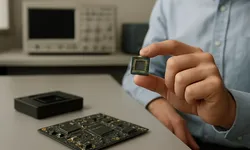
Miniaturization has been the engine of modern electronics for decades. Pack more transistors and memory cells into the same area, and devices get faster, cheaper, and more capable. But the familiar trade-off has become harder to ignore: as components shrink, heat and energy loss often rise, and battery-powered gadgets pay the price.
Researchers now say they have built a memory chip that pushes against that trend. Instead of accepting that smaller means leakier and hotter, the team reports a device architecture that reduces energy loss as it scales down-an inversion of what many engineers have come to expect from extreme miniaturization.
If the concept holds up beyond the lab and can be manufactured reliably, it could reshape how memory is designed for phones, laptops, and edge devices that struggle with thermal limits and power budgets.
Why memory is a major heat and battery culprit
When a smartphone warms up during gaming, video capture, or navigation, the heat is not coming from a single component. It is the combined effect of compute cores, graphics, radios, and-often overlooked-memory. Modern systems constantly move data between processors and memory, and that motion costs energy.
Memory also consumes power even when it is not actively being written. Some memory types require periodic refresh operations. Others suffer from leakage currents that become more pronounced as devices shrink. In both cases, energy turns into heat, and heat forces chips to throttle performance or drain batteries faster.
The industry has responded with clever packaging, better power management, and new memory standards. Yet physics keeps tightening the screws. As feature sizes approach the limits of conventional materials and structures, the "free" gains from scaling become harder to capture.
The miniaturization rule researchers are trying to break
A common pattern in electronics is that shrinking devices increases certain losses. At very small scales, insulating barriers can become thin enough that electrons tunnel through them. Interfaces and defects matter more. Electric fields intensify. All of that can raise leakage and waste energy, even if the device is nominally "off."
For memory, this is a particularly sharp problem because memory arrays contain enormous numbers of repeating cells. A tiny inefficiency in one cell becomes a large inefficiency when multiplied across billions of them. That is why memory design is often conservative: reliability and predictable behavior matter as much as raw density.
The new work is notable because it claims the opposite scaling behavior: as the device is reduced to an extreme scale, energy loss drops rather than climbs. That is an unusual result in a field where engineers often spend years fighting the side effects of shrinking.
What's different about the new memory device
The researchers' approach centers on two ideas: shrinking the active components to an extreme scale and redesigning the structure so that the dominant loss mechanisms change. Rather than simply making a familiar memory cell smaller, the team rethinks how the device stores information and how current flows through it.
In many conventional designs, scaling down can amplify parasitic effects-unwanted resistances, capacitances, and leakage paths that waste energy. A structural redesign can sometimes shift the balance so that the device operates in a regime where those parasitics are less damaging, or where the switching mechanism itself becomes more efficient.
The reported result is a memory element that, when miniaturized, reduces energy dissipation instead of increasing it. The implication is not just a smaller memory cell, but a memory cell that becomes more power-friendly as it gets denser.
A quick primer: how memory burns power
To understand why this matters, it helps to separate memory power into a few buckets:
- Dynamic switching energy: the energy required to change a bit from 0 to 1 or back again, often tied to charging and discharging tiny capacitive nodes.
- Static or leakage power: energy lost even when the memory is idle, due to leakage currents or the need to maintain state.
- Peripheral overhead: energy used by sense amplifiers, wordline drivers, and control circuits that sit around the memory array.
Shrinking a memory cell can reduce switching energy because smaller structures can require less charge to flip. But leakage and variability frequently rise at the same time, and peripheral circuits do not always scale down as cleanly as the cell itself.
A design that reduces energy loss with scaling suggests it is not only lowering switching energy, but also suppressing or avoiding the leakage mechanisms that usually get worse at tiny dimensions.
Why "cooler memory" could change device design
Thermals are now a first-order constraint in consumer electronics. Thin phones have limited room for heat spreaders. Laptops chase performance but must stay comfortable to touch. Wearables and earbuds have even tighter envelopes and smaller batteries.
Memory sits close to processors and often shares the same thermal budget. When memory runs hot, it can force the entire system to back off. Lower-loss memory could give designers more headroom: either higher sustained performance at the same temperature, or similar performance with less battery drain.
There is also a systems angle. If memory becomes more energy-efficient, device makers may be able to keep more data closer to the processor without paying as much of a power penalty. That can reduce data movement, which is increasingly one of the biggest energy costs in modern computing.
Implications for AI and edge computing
Even without naming specific products, the direction is clear: more workloads are moving onto battery-powered devices. On-device AI features-image enhancement, speech processing, and personalization-often rely on frequent memory access and large working sets.
When AI models run locally, memory bandwidth and energy become limiting factors. A memory technology that scales to higher density while reducing losses could help edge devices run more capable models without overheating or sacrificing battery life.
Data centers also care about memory power, but the immediate appeal here is the mobile and embedded world, where every milliwatt matters and thermal throttling can be user-visible.
From lab device to real chips: the hard part
A promising memory element is not automatically a manufacturable memory product. The path from a research demonstration to a commercial chip typically runs into the same obstacles:
- Yield and variability: memory arrays demand uniform behavior across huge numbers of cells. Tiny variations can cause errors or reduce endurance.
- Integration: new materials or structures must fit into established semiconductor process flows, or justify the cost of new tooling.
- Reliability: memory must retain data, survive repeated writes, and operate across temperature ranges for years.
- Peripheral circuitry: even if the cell is efficient, the surrounding circuits can dominate power unless the whole architecture is optimized.
The researchers' claim-lower energy loss with scaling-targets one of the most stubborn problems in advanced electronics. But the industry will still ask familiar questions: how stable is the effect across many devices, how sensitive is it to defects, and can it be produced in dense arrays?
Those questions do not diminish the result. They define what comes next.
How this fits into the broader memory landscape
Memory innovation is happening on multiple fronts. Traditional DRAM and flash continue to evolve, but they face scaling challenges and rising complexity. Meanwhile, alternative memories-often grouped under "emerging non-volatile memory"-aim to combine speed, endurance, and low power in different ways.
The new device described in the research adds another option to that landscape, with a particular emphasis on energy behavior at extreme scales. That focus matters because many proposed memories look attractive in one metric but stumble when scaled down or when placed into dense arrays.
If a memory cell truly becomes less lossy as it shrinks, it could complement existing approaches rather than replace them outright. Hybrid systems are common in practice: different memory types serve different roles based on speed, cost, and power.
What to watch next
The most revealing next steps will likely be practical demonstrations that move beyond a single device or small test structure. Observers will look for:
- Evidence that the low-loss behavior persists across many cells and across wafers.
- Operation under realistic voltages and temperatures relevant to consumer devices.
- Clear read/write mechanisms that can be implemented with standard peripheral circuits.
- Early signs of endurance and retention characteristics suitable for real workloads.
Memory is one of the most unforgiving parts of chipmaking. It must be dense, fast, cheap, and reliable, all at once. A design that flips the usual scaling penalty into a scaling advantage is the kind of idea that gets attention precisely because it challenges the default assumptions.
For consumers, the promise is simple: devices that stay cooler and last longer on a charge. For the industry, the promise is more subtle: a new knob to turn when the old ones-shrinking transistors, raising clock speeds, adding more cores-no longer deliver without overheating.