Energy storage research has a familiar bottleneck: promising ideas often take too long and cost too much to test at meaningful scale. That friction matters because wind and solar power do not arrive on demand, and grids need ways to shift energy from when it is generated to when it is used.
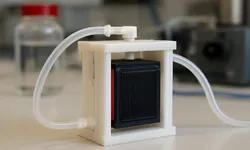
Researchers at Queen's University Belfast have developed a 3D-printed battery aimed at easing that bottleneck. The project sits in a category of storage technologies known as flow batteries, and its core promise is practical: make it faster to build, modify, and evaluate new designs so labs can iterate more quickly.
The work also touches a sensitive nerve in academia. Breakthroughs are often steered toward patents and licensing as universities look for revenue and funding. In this case, the researcher involved has acknowledged briefly considering that route, before leaning into a more open, research-enabling approach-an angle that could shape how widely and quickly the design is adopted.
Why flow batteries matter for renewables
Most people associate batteries with sealed packs-lithium-ion cells stacked into modules and managed by electronics. Flow batteries work differently. They store energy in liquid electrolytes held in external tanks, and pump those liquids through a reactor where electrochemical reactions occur.
That separation between "energy" (the size of the tanks) and "power" (the size of the reactor and flow hardware) is the key engineering idea. If you want more hours of storage, you can increase tank volume without necessarily redesigning the entire electrochemical stack. That makes flow batteries attractive for stationary applications where space is less constrained than in vehicles.
Flow systems are also a natural fit for long-duration storage discussions, where the goal is to cover multi-hour gaps in renewable output. They are not the only option-pumped hydro, compressed air, thermal storage, and various chemistries all compete-but flow batteries remain a serious contender because they can be designed for repeated cycling and potentially long service life.
What 3D printing changes in a battery lab
Battery research is often slowed by the physical reality of prototyping. A new channel geometry, electrode arrangement, or sealing method can require custom machining, specialized parts, and long lead times. Even small changes can cascade into new tooling and new assembly procedures.
3D printing offers a different workflow. Instead of waiting for parts to be machined, researchers can adjust a digital model, print a revised component, and test it quickly. That speed matters in flow batteries because fluid dynamics and electrochemistry are tightly coupled: channel shapes influence pressure drop, mixing, and how evenly reactants reach the electrode surfaces.
A 3D-printed flow battery design can also make it easier to explore unconventional architectures. Researchers can try different internal manifolds, lattice-like supports, or compact cell layouts that would be difficult or expensive to fabricate with traditional methods. The result is not automatically a grid-ready product, but it can be a better experimental platform.
Inside a flow battery: the parts that benefit from rapid iteration
A typical flow battery includes tanks, pumps, tubing, a cell stack (or single cell in a lab setup), electrodes, and a membrane or separator. The electrochemical "heart" is where the most sensitive design trade-offs live.
Several components are particularly suited to rapid prototyping:
- Flow frames and channels: The geometry that guides electrolyte across electrodes affects performance and efficiency. Poor distribution can leave parts of the electrode underutilized.
- Manifolds and seals: Leaks and uneven flow are common headaches. Iterating on sealing surfaces and compression features can improve reliability in test rigs.
- Cell housing: Lab cells need to be robust enough for repeated assembly and disassembly, especially when researchers swap membranes, electrodes, or current collectors.
- Modular interfaces: A design that makes it easy to change one variable at a time-without rebuilding the whole apparatus-can improve experimental quality.
By focusing on the physical platform, a 3D-printed approach can help researchers spend more time evaluating chemistry and system behavior, and less time waiting for parts or troubleshooting mechanical mismatches.
From "breakthrough" to usable tool: what to watch
A lab-friendly battery design is not the same as a commercial battery. Flow batteries intended for the grid must meet demanding requirements: chemical compatibility over years, stable membranes, predictable maintenance, and cost-effective manufacturing at scale.
3D printing can be a bridge rather than the destination. In many industries, additive manufacturing is used to validate designs quickly, then mature products shift to injection molding, machining, or other high-throughput methods. Energy storage could follow the same pattern: print to learn, then manufacture to deploy.
That said, additive manufacturing is not limited to prototypes. Some parts-especially complex internal channels or low-volume specialized components-may remain good candidates for printing. The more important question is whether the printed design improves the pace and quality of research enough to influence what gets commercialized later.
The commercialization dilemma in university research
Universities often face a tension between open science and monetization. Patents and licensing can fund labs and satisfy technology transfer goals, but they can also slow dissemination or limit who can build on a design.
The Queen's University Belfast project arrives with an unusually candid framing: the researcher involved has described briefly considering selling the product, before moving away from that "cynical" instinct. That matters because research tools gain value when they spread. A platform that many labs can replicate becomes a shared baseline for comparing results, reproducing experiments, and building incremental improvements.
If the design is made accessible, it could lower the barrier for smaller research groups, teaching labs, or early-stage startups to experiment with flow battery configurations. That is not a guarantee of better batteries, but it can broaden participation in the work.
Implications for the energy storage industry
Energy storage is crowded with competing approaches, and the industry's near-term focus often lands on deployment-ready systems. Yet the pipeline of future storage technologies depends on research infrastructure: test cells, standardized methods, and repeatable experiments.
A 3D-printed flow battery platform could influence the industry in a few practical ways:
- Faster design cycles: Shorter iteration loops can help identify promising geometries or operating regimes sooner.
- Better comparability: If multiple groups use similar hardware, results across labs can be easier to compare, reducing confusion caused by bespoke rigs.
- Workforce development: Hands-on platforms can help train engineers in electrochemistry, fluid handling, and system integration-skills that matter in grid storage.
- Early validation for startups: Young companies often need credible data quickly. A flexible test platform can support early-stage proof-of-concept work.
The broader implication is that innovation is not only about discovering new chemistries. It is also about improving the tools that make discovery routine.
Technical challenges that still shape flow batteries
Even with better prototyping, flow batteries face known engineering and materials challenges. Membranes must balance selectivity (keeping active species where they belong) with low resistance (to reduce energy losses). Electrodes need high surface area and good conductivity while resisting degradation.
Then there is the system layer. Pumps consume energy, and plumbing introduces pressure losses. Tanks, sensors, and control systems add complexity compared with sealed battery packs. Those trade-offs do not disappear with 3D printing, but rapid iteration can help researchers quantify them earlier and design around them.
For renewable integration, the most valuable storage is often the storage that can be maintained and operated predictably. That pushes research beyond peak performance numbers and toward durability, serviceability, and real-world operating envelopes.
A research accelerator, not a single silver bullet
The Queen's University Belfast 3D-printed battery should be read as an enabling development: a way to speed up the experimentation that underpins future storage systems. It is a reminder that progress can come from manufacturing methods and lab infrastructure as much as from new materials.
If the design is shared widely and proves easy to reproduce, it could become a common starting point for flow battery studies. That would not settle the debate over which storage technologies will dominate the grid, but it could make the debate more evidence-driven.
For a sector that needs both rapid deployment and sustained innovation, tools that compress the research timeline are hard to ignore.